

























Ambitious Plans for the New Belgrade
The Centre for the Promotion of Science
by Ted Sandstra
In the process of reinventing itself, the Serbian capital of Belgrade, once the political center of Yugoslavia before its dissolution into a number of smaller nation states, is steering away from its obsession with its nationalist past, and, with its application for entry into the European Community, is promoting cultural as well as economic progress as its top priorities. As part of this new direction, the City staged recent competitions for two city projects, bringing attention to the needs of Belgrade as a large city that not only continues to grow, but is soliciting ideas that speak to a civic and national identity that is intended to redefine significant historical locales within its geography. Thus, in the tradition of the Grande Projets, the Serbian administration announced competitions for a Center for the Promotion of Science; and also the Hala Beton Waterfront Centre 2011 and Kalemegdan Park on the Danube, the former located in Block 39 of the New Belgrade plan, the latter located just across the Sava River from it.
New Belgrade was originally designed in the 1950’s as the connective tissue between two cities – Belgrade to the east and Zemun to the west. Belgrade was the furthest point west of the Ottoman Empire while Zemun represented the Austrian-Hungarian empire to the west. By finding a way to bind these two cities with a new, modern housing district, Tito’s regime intended to indicate a direction forward for nascent state of Yugoslavia.
Why the city regarded a new Centre for Promotion of Science, as one of its top priorities for an international competition is clear from the competition brief:
Science Centers inspire curiosity and support learning about science from early ages. In the area of knowledge-based societies a modern science centre can play a central role in dissemination of scientific culture and the strengthening of research, not only for young generations, but also for adults.
First Prize:
Wolfgang Tschapeller (Austria)
ZTGMBH Architekten
Vienna, Austria


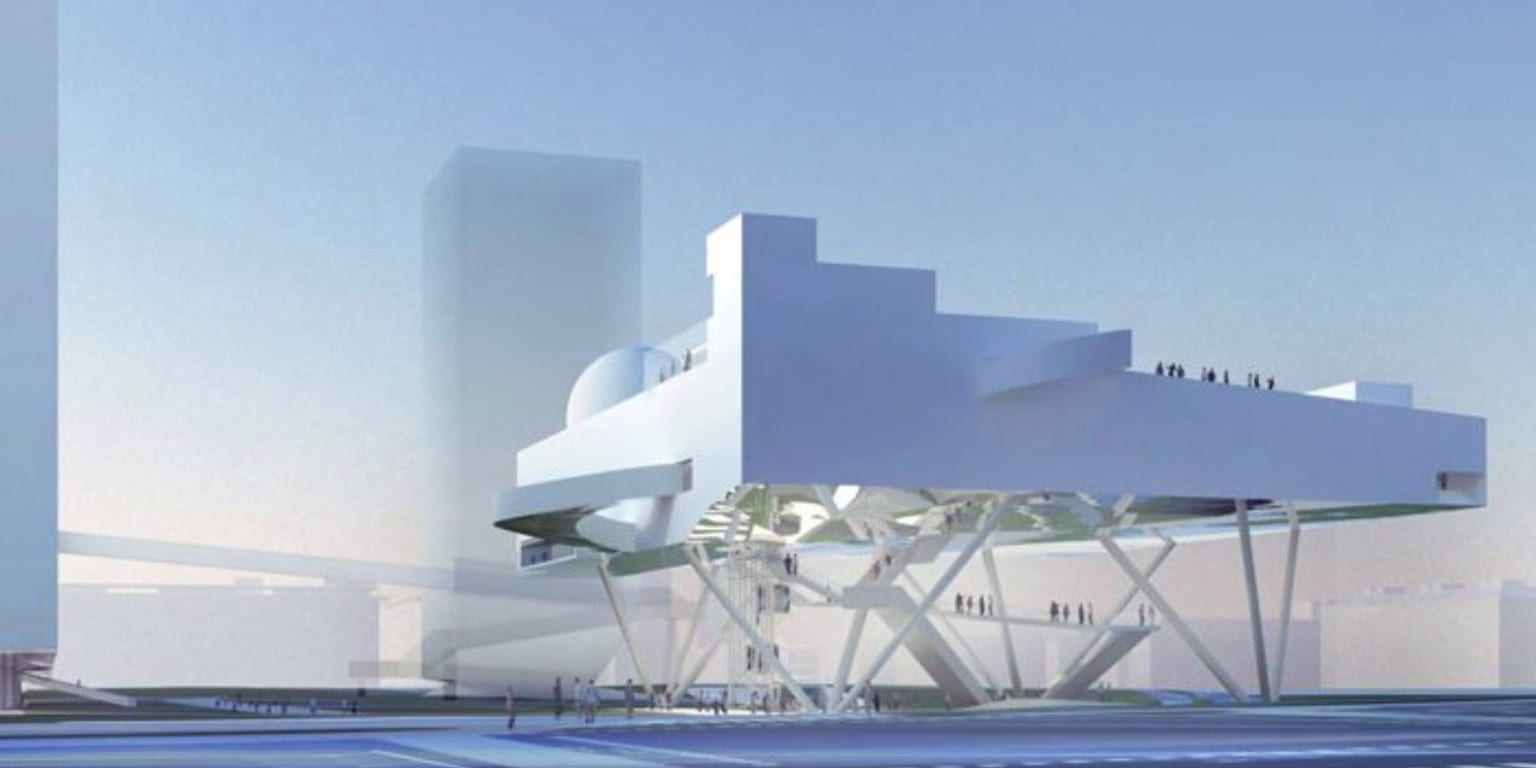
There can be little doubt that an eye-catching design was what the city was after, and the winning design by the Austrian architect, Wolfgang Tschapeller, certainly fulfilled that requirement. By locating the program above the street with remarkable structural simplicity and clarity, one can surmise that this approach caught the attention of the jury over other, less successful attempts to reach for height and visibility in an urban landscape dedicated to the automobile. Elevating the program also frees up space for the development of additional amenities for pedestrians at street level.
Raising the exhibition area above the ground plane, according to the author, follows the principles of the Athens Charter as set out by CIAM (International Congress of Modern Architecture). This ties the design to the history of the site, which was conceived at a time when the Athens Charter held sway over urban planning. The competition brief stated:
At that time, futuristic urban planning was carried out, with a clear orthogonal street system, wide boulevards, fast traffic, open and half open blocks with macro and micro ambiences and appropriate following content, green zones and good environmental qualities.
Once one ascends up to the main level, the remainder of the design possesses a functional and very restrained distribution of the program. The shell of the building clearly delineates the architecture’s internal features: the hemispherical planetarium, tubes describing vertical circulation, raked seating for the auditorium and a large, unbroken box for a highly flexible exhibition space. This rational utilization of space is consistent throughout the structural solution as the author outlines the use of void forms in the concrete slab to reduce deadweight. Although there is a reward in the ever-improving view over New Belgrade as the visitor ascends the ramps and moves into the underside of this spaceship, the unsheltered vertical circulation path would seem to demand some endurance of the user in inclement weather. Perhaps some enclosure (similar to the Pompidou?) will be developed in order to protect visitors from the winter wind.
The criteria for the jury’s evaluation of the winner are clear from its concluding statement:
Yet even as the building’s form appears radical, the construction is simple, straightforward, well-considered and well-calculated. The Jury has come to the conclusion that this project precisely fits both the requirements, and aspirations, for the proposed institution, as well as for the city—in which it will provide a new, welcome landmark.
Second Prize:
Sou Fujimoto Architects (Tokyo, Japan)
Consultant/engineer, Ove Arup Japan Pty. Ltd.


Second prize went to Sou Fujimoto Architects of Japan for a scheme that is similar in many ways. In the entry “Forest of Science,” the architects also privilege the landscape and form structural elements around groups of trees to hold up a canopy above the program. Some of the program is then sunken into the landscape with this canopy and forest of trees towering above. This scheme highlights a change in our understanding of the landscape and our domination of nature since the regular grid of New Belgrade was first laid out.
Third Prize:
ARCVS (Belgrade, Serbia)
Consultant for structural design, Sreto Kuzmanović, civil engineer
Consultant for traffic design, Slaviša Milosavljević, traffic engineer


Third prize went to a proposal as radical as the winning proposal although it took a completely different form. The proposal by a Serbian team stretches the building over the length of the entire site (some 300 meters) to make an urban walkway. The program is distributed over this entire length, a feature, which the jury commented held it back in fulfilling the competition brief, but which allowed the team to lay a strong organizing principle at an urban scale. While the winning scheme privileges the view over the city and highlights the Center for Promotion of Science and as an icon to be viewed, the third prize scheme privileges the pedestrian experience, essentially making the building an inhabited sidewalk through the site. This scheme challenges the automobile driven urban grid that formed New Belgrade and offers an alternative to the shopping mall for a public space in New Belgrade.
As ambitious as this competition is, its realization may be another matter. The original plan recommended by local authorities suggested that the project could be completed by the end of 2012. For a project this complicated, 4-5 years might be a better estimate—that is, unless you are in China.
Honorable Mention (Awarded):
PESQUERA ULARGUI ARQUITECTOS, S.L.P (Madrid, Spain)


Honorable Mention (Awarded):
Vladimir Lojanica, D.Eng.Arch, Associate Professor (Belgrade, Serbia)
with Sonja Pešterac, D.Eng.Arch., Marija Ćorluka – Mijović, D.Eng.Arch., Vladimir Cvejić, D.Eng.Arch., Marija Konstandinidis,M.Arch., Nikola Ilić,M.Arch.


Honorable Mention (Awarded):
Durig AG, Jean – Pierre Durig (Zurich, Switzerland)


For images of the other honorable mentions, go to: http://www.blok39.com/index.php?option=com_content&view=article&id=60&Itemid=57
Ted Sandstra, M.Arch, is presently with Artisan Architects in Louisville, Kentucky. He received an MA in the History and Theory of Architecture from McGill University and a Masters in Architecture from the University of British Columbia. Before moving to Louisville, he worked both in California and Germany with Behnisch Architekten. He is a registered architect in the province of Alberta, Canada.