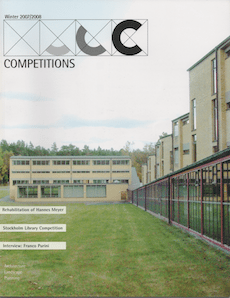
When we recently learned that Bauhaus Director Hannes Meyer’s Bundesschule ADGB (German Workers’ Seminar in Berlin/Bernau) had been designated a World Heritage site by UNESCO, we felt it was an opportunity to toot our own horn. Back in 2007, when a renovation of the complex had just been completed, we were given a tour of the facility and subsequently did a feature article on that 1928 competition in our COMPETITIONS quarterly magazine (Vol. 17, #4). Hardly six months passed before we learned that the site had received the initial award for the 2008 World Monuments Fund Modernism Prize. In most cases, we wouldn’t have made a case for any influence that may have resulted from our publication, except that one member of that 3-person jury happened to be on our distribution list. So when the UNESCO designation occurred, we also received congratulations from a member of the German committee responsible for the renovation—for any role we may have played in the matter.
Read more…

Winning entry by Hall McKnight
This design competition for the historic core of the Gallaudet campus and adjacent public realm focused on themes of cultural exchange and creative placemaking. It ran from September 2015 to November 2016.
Background
Established in 1864, Gallaudet University is the world’s only liberal arts university in which all programs and services are designed to accommodate deaf and hard-of-hearing students. One of the challenges faced by the competitors was the use of “DeafSpace” in their proposals—design principles based on the knowledge that the built environment, largely constructed by and for hearing individuals, presents a variety of challenges to which deaf people have responded with a particular way of altering their surroundings to fit their unique ways-of-being. Examples of DeafSpace design elements can be found on the Gallaudet campus in two of its buildings. This project is the first time these design principles will be incorporated into a public space off the Gallaudet campus.
Throughout the competition, the Gallaudet community participated in a number of design events, including the Shape Gallaudet launch, a colloquium or discussion, and a charrette, also known as a live design critique.
The competition featured two parallel initiatives:
Shape Gallaudet invited ideas, inspirations, sketches, images, and videos from students, staff, alumni, local residents, and supporters of Gallaudet, both international and stateside. The finest of these were used to inform the briefing to be given to the design teams shortlisted after the first stage.
A Request for Proposals invited applications from multidisciplinary teams of designers, landscape architects and specialists in human behavior, performing and fine arts, communication technology, wayfinding and engineering disciplines, amongst others.
Read more…

Image: ©Gort Scott; courtesy MRC
St Hilda’s College has selected Gort Scott to design a new £10m+ front-of-house development for its exceptional riverside site in the conclusion of the Redefining St Hilda’s invited design competition, organized by Malcolm Reading Consultants. St Hilda’s College was one of the original group of five women’s colleges founded at Oxford at the end of the nineteenth century. Since 2008, it has selected its undergraduates and graduates without regard to gender. St Hilda’s now has one of the highest proportions of international undergraduate students of any college within the University.
Read more…

A Holistic Strategy for a Community Learning Environment

Winning entry by CEBRA (image © CEBRA, courtesy Strelka)
Can it be that pedagogues from all over the world will soon be traveling to the far reaches of Siberia to examine the workings of a school, which not only will be catering to average students, but also feature a live-in community offering an optimal educational environment for disadvantaged children. A competition for this ‘model’ school occurred in 2015, and the winning entry came from a team led by the Danish firm, CEBRA.
Read more…
Honoring the Old, In with the New
Laval University School of Architecture “Emblematic Addition” Ideas Competition
by Stanley Collyer

Addressing an addition to a centuries-old seminary building in the heart of historic Québec—designated a UNESCO World Heritage Site— would represent a unique challenge to any architect. To probe the boundaries of this scenario, the Laval University School of Architecture, celebrating the 50th anniversary of its founding, sponsored a one-stage ideas competition, open to professionals and students alike for an “emblematic addition” to the heritage building where it resides.
Read more…
by Gretchen Milliken 
Winning entry by 3XN (image © 3XN)
The intention of the Mälardalen University competition is to evoke a holistic architectural approach to the design one of Sweden’s largest universities with 12,000 students and over 900 faculty and employees. The University is well known for its strong partnerships with regional businesses and municipalities with a focused curriculum on education, health, technology and economics. Six established research departments further strengthen the University’s program, the flagship being Innovation and Product Development.
Read more…
by Dan Madryga
The finalists (from left to right): Perkins+Will, Adrian Smith+Gordon Gill, Goettsch Partners
Northwestern University is getting a major architectural facelift. Over the past few years, the university has staged several invited design competitions for large-scale building projects on its Chicago and Evanston campuses. A new 152,000 square foot building for the Bienen School of Music and Communication, designed by Goettsch Partners, is currently under construction and slated to open later this year. Meanwhile the 410,000 square foot Kellogg School of Business—for which Toronto firm KPMB beat out Kohn Pedersen Fox, Adrian Smith + Gordon Gill, and Pelli, Clark & Pelli for the commission—is expected to be ready for occupancy in 2016. As large as these projects are, Northwestern’s most recent invited competition dwarves them both in scale, budget, and ambition: a brand new Medical Research Center for the Feinberg School of Medicine.
Bienen School of Music © Goettsch Partners
ÂÂÂÂÂÂÂÂÂÂÂÂÂÂ
Kellogg School of Business © KPMB
The new Medical Research Center is a huge undertaking for Northwestern. Once complete it will introduce 1.2 million square feet of state-of-the-art lab space, with which the University expects to attract an additional $150 million a year for medical research, as well as create 2,000 new full-time jobs. Needless to say, the project is at the forefront of the university’s projected master plan.
Of course the architectural evolution of any urban campus necessitates some selective purging of the existing building stock. For the Medical Research Center’s central location on the Chicago campus, this has unfortunately meant the loss of Bertrand Goldberg’s 1975 Prentice Women’s Hospital. This move created no small amount of controversy amongst preservationists and fans of Goldberg’s distinctive, sculptural concrete cloverleaf form. Goldberg was a Chicago architect—a protégé of Mies van der Rohe—who also designed the instantly recognizable twin corncob towers of Marina City. Originally hailed for its innovative engineering and striking form, the Prentice took an innovative approach to organizing medical wards in clusters, thus lending to its distinct form. General reactions have always been mixed: for some it was an iconic work of Brutalism, for others it was simply an eyesore. Either way the hospital was clearly dated by the 21st century standards of functionality, and Northwestern’s development future did not include the Prentice.
Proponents of the Prentice pulled out all the stops to try and save the endangered hospital. Preservationist groups sought to protect it with a Landmark status designation that was ultimately denied. Chicago’s Studio Gang offered up a striking design idea that would save and incorporate the Prentice into the new research center. The efforts even extended to an ideas competition. In 2012, the Chicago Architectural Club organized “Future Prentice” as the timely theme of the annual Chicago Prize Competition. Entrants were challenged to find creative solutions for repurposing the old hospital building, in hopes that thought-provoking design could spark a useful public dialogue about solutions that went beyond full-on preservation or wholesale demolition. In addition to the 71 entries received, the Chicago Architectural Club commissioned designs from ten up-and-coming local architecture firms. Together these 81 ideas were displayed at the Chicago Architecture Foundation’s “Reconsidering an Icon” exhibit in late 2012 and early 2013.
The Future Prentice entries ranged from compelling yet largely grounded adaptive reuse ideas (the first prize entry by Cyril Marsollier and Wallo Villacorta imagines the Prentice’s distinctive concrete shell as a museum presented amongst the boxy volumes of a new research lab facility), to wildly left-field theoretical concepts (the second prize entry by Noel Turgeon and Natalya Egon, where various architectural additions are vertically stacked upon the Prentice to form a “timeline of trends in architecture”). In the end, the competition might have created an interesting dialogue but not with the people who really needed convincing. Given the longstanding plans to demolish the vacant hospital, Northwestern made it clear that all ideas for saving the Prentice would not be seriously reviewed by the University. Like the attempts to enact landmark status, the Future Prentice ideas competition was too little, too late.
Not long after the ideas competition came and went, Northwestern officially released their request for qualifications for the new Medical Research Center, with proposals due in April 2013. The RFQ was sent to 23 architecture firms, six of which were local Chicago firms, and most of which had previous experience in large research and medical projects.
Northwestern’s program called for a research center that would be implemented in two phases. Phase 1 will consist of a 600,000 square foot, 12-story mid-rise complex to fit the former site of the Prentice, with a groundbreaking slated for early 2015 and completion forecasted for 2018 or 2019. It will also serve as a base for the second phase, capping Phase 1 with a multistory tower featuring even more lab space and offices. It should be noted that there is currently no timetable or funding in place for the Phase 2 tower. Thus it is of particular importance that the design for Phase 1 does not end up looking like a vacant pedestal, should Northwestern’s long-term development goals not pan out.
The design criteria included: an iconic design that respected the campus context and would be a major asset to Northwestern, the Streeterville neighborhood, and the Greater Chicago community; a building that best met all the functional needs of the Medical School; a building that could be easily implemented in two phases; a design that respected and enhanced the neighborhood connections at ground level (particularly with the labs of the adjacent Lurie Medical Research Center); and a design that provided extensive green space. The University also expected at minimum a LEED silver ranking.
Similar to Northwestern’s most recent invited competitions, the RFQ procedure was a hybrid between a pure design competition and an interview. Or rather a series of interviews, as the shortlisted teams underwent a series of meetings during the design phase with the client group. The university prefers that the names of this evaluation committee remain anonymous, although Northwestern spokesperson Alan Cubbage has disclosed that the group included members of the University Board of Trustees as well as key administrators of the Feinberg School of Medicine. Two outside architects also sat in as advisors.
During these design meetings, the committee offered comments and critiques to each shortlisted team. Northwestern has chosen to keep the specifics of these meetings confidential, but we do know through reliable sources that the each team felt that the evaluation comments were well founded, and that no single competitor was singled out for criticism.
By November of 2013, the three shortlisted teams final designs were ready for a final verdict. In a gesture of transparency, Northwestern officially unveiled the resulting shortlist designs in an exhibit at the Lurie Medical Research Center. The university welcomed and recorded comments from faculty, staff, students, and other visitors to this public display. The three projects on display were by Perkins+ Will, Adrian Smith+Gordon Gill, and Goettsch Partners. It is good to see that all three firms have local Chicago offices; it seems fitting to replace a building by the indelibly Chicagoan architect Goldberg with a new generation of successors.
A casual observer of the shortlisted designs could be forgiven for finding them all remarkably similar. In fact, no one design stands out as wildly out of the box, an obvious winner. Instead we see three elegant, highly competent, if rather predictable options. Part of this stems from the nature of the building program—the rigid constraints of medical and research facilities often have a way of confining creativity. There’s also the persistent issue of making glazed skyscrapers energy efficient. Each entry uses high-performance building skins, which give them similar façade materiality and depth, not to mention employment of textbook sun shading techniques (cue the obligatory vertical fritted glass fins on the east and west facades). Just as the chunky Brutalism of the Prentice had become emblematic of 1970s modern architecture, the sleek, crystalline forms of the shortlist are very much of our own time. There’s nothing wrong with that, but it would have been interesting to see at least one unconventional curve ball, even if it had no chance of winning the commission. *
Read more…
An Academic Cluster Pointing to the Future
The Vienna School of Economics Campus Plan
By Stanley Collyer
School of Economics Library by Zaha Hadid (all photos by Stanley Collyer)
At the turn of the 21st Century, the Vienna School of Economics (Wirtschaftsuniversität Wien), the largest of its kind in Europe, was bursting at the seams. Over 23,000 students were scattered throughout different locatons in the city. When it became obvious that it would be necessary to consolidate the programs at a central location, the decision was made to select an area near the Prater for the new campus—the site of the World Exhibition Area and Fairgrounds. The building program was ambitious, with a number of facilities planned to accommodate all the programs, and the strategy was typically European, as student dormitories were not envisaged as an integral part of the overall campus plan.
To begin with, a local Viennese firm, BUSarchitektur, was engaged to complete a masterplan for the site, and a number of renowned architects were then commissioned to design the various facilities: No.MAD Arquitectos, CRABstudio Architects, Estudio Carme Pinós, Atelier Hitoshi Abe, and BUSarchitektur, the latter local firm being the author of the masterplan.
Read more…
University of Chicago North Campus Student Residence
Winning entry by Studio Gang with Mortenson Construction—Image courtesy Studio Gang ©University of Chicago
Like many American universities in the late 19th and early 20th centuries, the University of Chicago viewed Gothic architecture as a recognizable symbol to suggest academic excellence in the tradition of Ivy League universities and Oxford. In this, Chicago was not alone, as other schools used a similar formula to imply a connection to a pre-existing academic tradition—Duke University and Butler University in the 1920s being prime examples. As time passed, and to accommodate Chicago’s reputation architecturally as a forward-looking community, the university gradually hired contemporary architects such as Eero Saarinen, Mies van der Rohe, Edward Larrabee Barnes, Walter Netsche and Harry Weese to add to the university’s built fabric. Beginning with the early 21st century, the look on the campus has been updated even more to reflect current trends with buildings by Cesar Pelli, Helmut Jahn, Rafael Viñoly, Joe Valerio, and most recently, the musum by Tod Williams and Billie Tsien.
Read more…
The Old and the New
Glasgow’s Schools of Art
photo by Iwan Baan, courtesy Steven Holl Architects
by Brian Carter
The competition, organized and administered by Malcolm Reading Consultants under the auspices of the Glasgow School of Art in 2009, focused on the selection of an architect to develop proposals for a new school of art on Renfrew Street to be built directly opposite the 1896 building designed by Charles Rennie Mackintosh. After some initial opposition from Scottish architects, the competition was opened to international participation. Seven practices (1) were reviewed by an eight member selection committee chaired by David MacKay. The committee agreed unanimously to appoint Steven Holl Architects, who worked in collaboration with JM Architects and Arup. (2)
ÂÂ
ÂÂ
Read more…
|
San Jose’s Urban Confluence Winner Cancelled
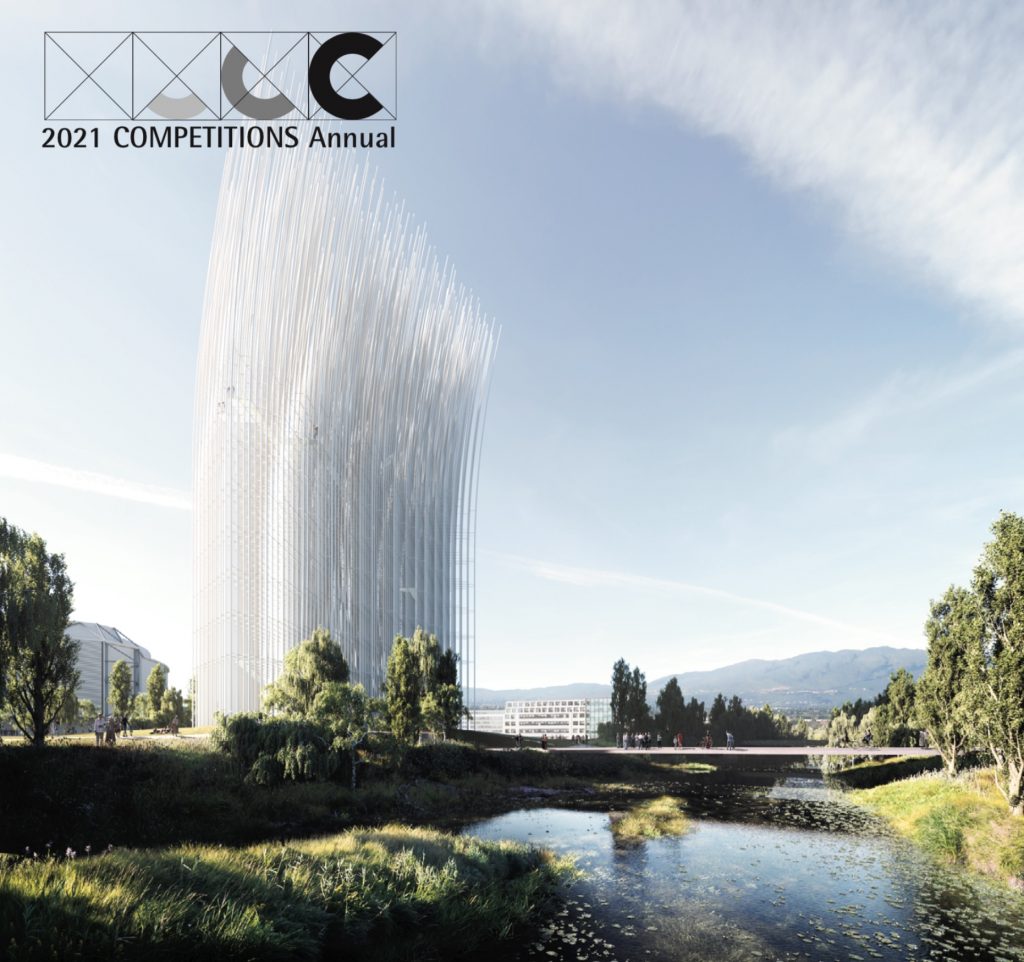
This week we received the news that the winning design for San Jose’s Urban Confluence competition by SMAR Architecture Studio has been cancelled. This comes after the original competition site was abandoned in favor of one more centrally located in downtown San Jose, Plaza de César Chávez. We can only assume that even this wasn’t enough to generate enough interest from major donors. From the very beginning of the competition, it appeared that the enthusiasm of those sponsoring the competition might be lacking links to potential donors with deep pockets—the hi-tech firms in Silicon Valley. After the competition resulted in a design that certainly entailed a major budget, the project had to be in trouble. The competition did produce a remarkable design; but this turned out to be another case where a competition, intended to generate enough public interest to fund a major project, came up short. -Ed
“A Museum for All”
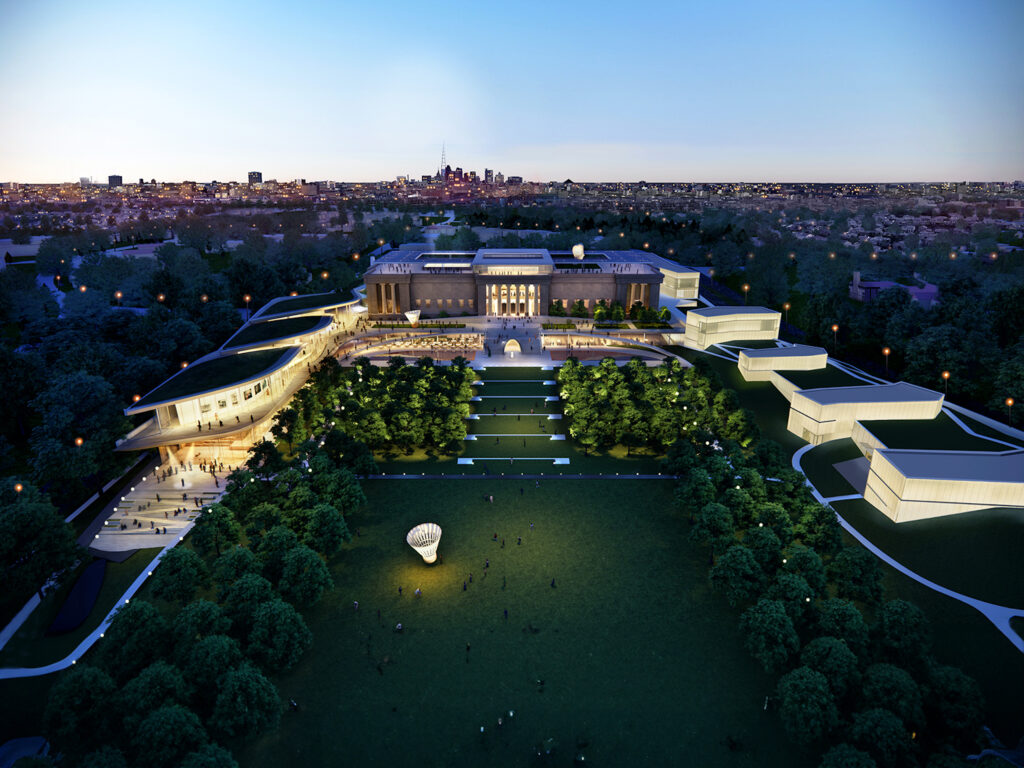
Winning entry by Weiss/Manfredi Landscape Architecture and Urbanism
Background
The Nelson-Atkins Museum of Art’s slogan “Creating a Museum for All” certainly reflects the efforts of many art museums to counter the notion that art museums exist primarily to cater to an elitist few. But one should note that this competition for an expansion of the museum’s capacity to serve a wider audience saw an initial step in this direction with the 1999 competition resulting in the Steven Holl addition, a series of pavilions stretching down one side of the large lawn area..
Read more…
Preparation and Organization of Design Competitions
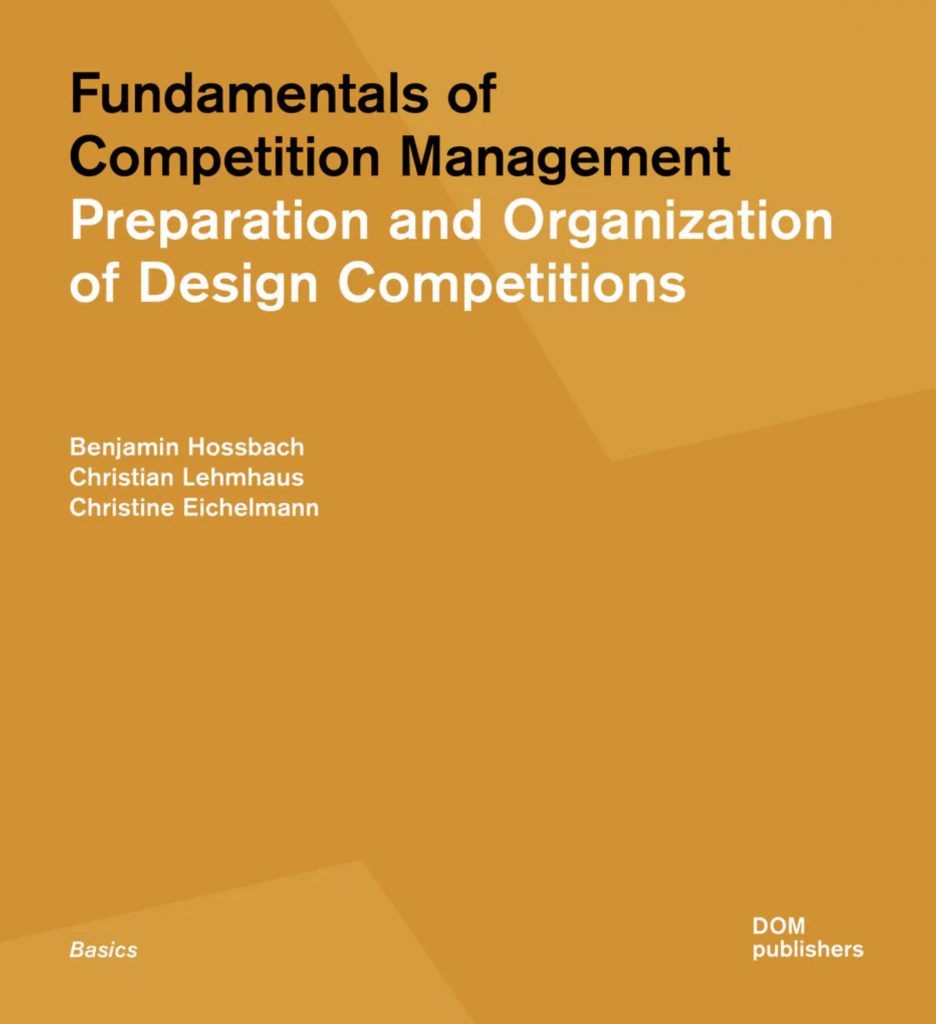
[phase 1] Benjamin Hossbach / Christian Lehmhaus / Christine Eichelmann
210 × 230 mm, 192 pp.
over 600 images
softcover
ISBN 978-3-86922-316-2 (English)
ISBN 978-3-86922-240-0 (German)
Dom Publishers
€48 in EU (For price abroad, see below)
Founded in 1998 in Berlin, Phase 1 has been a principal player in the organization and facilitation of design competitions, not only in Germany, but abroad as well. The accomplishments of the firm have been well documented in three volumes—The Architecture of Competitions—beginning in 2i006. Whereas these books mainly focused on the results of the competitions they have administered, the present work, Fundamentals of Competition Management, takes one from the very beginnings of the competition process to its conclusion. The authors envisioned the publication as “three three books in one: one „blue book“ with example projects, one „yellow book“ with statements and the „white book“ with the actual guideline to competition management.”
Although there have been a number of handbooks covering the administration of designcompetitions a study covering the entire process in such detail is a welcome addition to the the literature in this field. As a contribution to this important democratic process that has yielded exceptional design for decades, this volume is not only valid for Europe, but a current overview of the process for those globally who wish to raise the level of design by virtue of a design competition. -Ed
Foreign institutions wishing to obtain a copy of the book will recieve a discount to cover the cost of foreign shipping.
To obtain a copy for that offer, go to: accounting@phase1.de
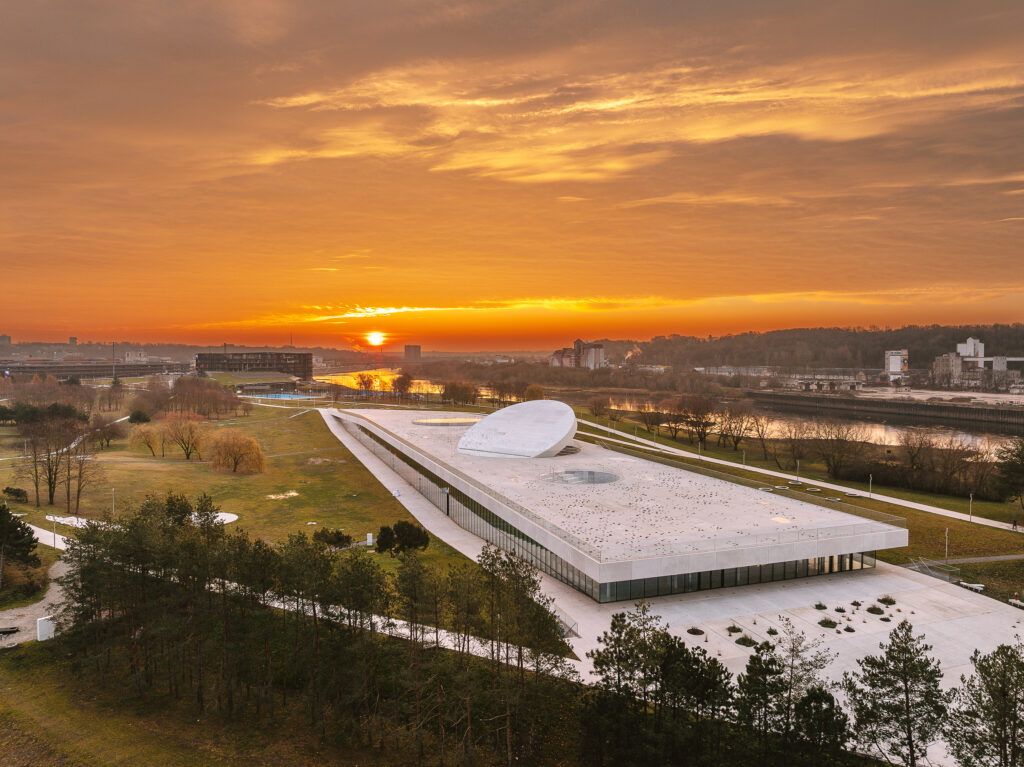
Since the recent realization of SMAR Architecture’s winning design we have now received images from a professional photo shoot. As an open competition for one of the more important projects in Europe at the time, we feel that full documentation of the process from start to finish was an important page in the history of architecture in the early 21st century. Documentation by us during the 2017 competition, with images from all finalists from the 144 entries is available at:
/competitions-static/2020/11/science-island-design-competition-finalists/
See more images…

Completed IMEX by Tuck Hinton Architects. Photo courtesy Anecdote
It is not often that we look back to a competition that occurred three decades ago that was also covered in detail by COMPETITIONS (Vol. 4, #4; pp. 14-27). What made the Chattanooga IMAX different back in 1994 was that the article covering that competition was authored by Prof. Marleen Davis, then Dean of the University of Tennessee’s School of Architecture and a member of the jury panel. This was not just a short article, covering the high points of the competition with a few talking points about the winning design. This 4,000+ word document also described in detail the jury’s observations about all the finalists, including the honorable mentions—one of the few times we have gained such a detailed glimpse in this country from the inside of the competition process.
Read more…
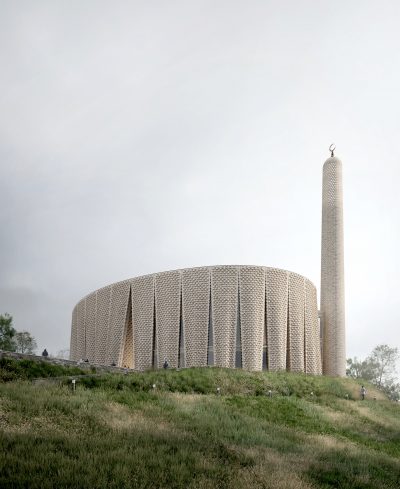
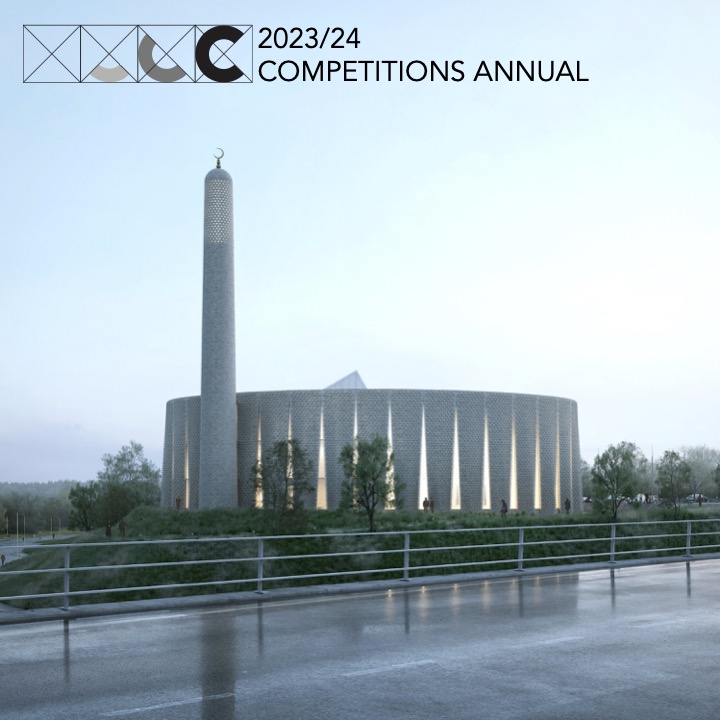
Winning entry by Luca Poian Forms Image ©Filippo Bolognese images
Good design seldom happens in a vacuum. And so it was with an international competition for a new mosque in Preston, U.K. A mid-sized city of 95,000, and located in Lancashire near the west coast and almost equally distant from London and Glasgow, Preston has a storied past, going all the way back to the Romans and the late Middle Ages, where it was the site of significant battles. During the Industrial Revolution, the city prospered, and it was not until after World War II that Preston experienced the British version of the U.S. Rust Belt. In the meantime, the city has experienced an upswing in economic activity, with an unemployment rate of only 3%. Aside from the appearance of new industries, the city has benefitted from the establishment of Central Lancashire University (CLU), which employs over 3,000 faculty and staff, and, as such, is one of the regions major employers. Any new university requires new facilities, and one of the most outstanding examples of this at CLU was the new Student Centre and Plaza, a result of a 2016 RIBA-sponsored competition won by Hawkins/Brown
Read More

Changdong Station winner – image ©D & B Partners Architects
Whereas international competitions for real projects have become a rarity lately, Korea is a welcome exception. Among the plethora of competition announcements we receive almost weekly, several have ended with foreign firms as winners. But the history of welcoming international participants does go back several years. One notable early example was the Incheon Airport competition, won by Fentress Bradburn Architects (1962-70).
Among the more recent successes of foreign firms was the Busan Opera House competition, won by Snøhetta (2013-) and the Sejong Museum Gardens competition, won by Office OU, Toronto (2016-2023).
Read more…
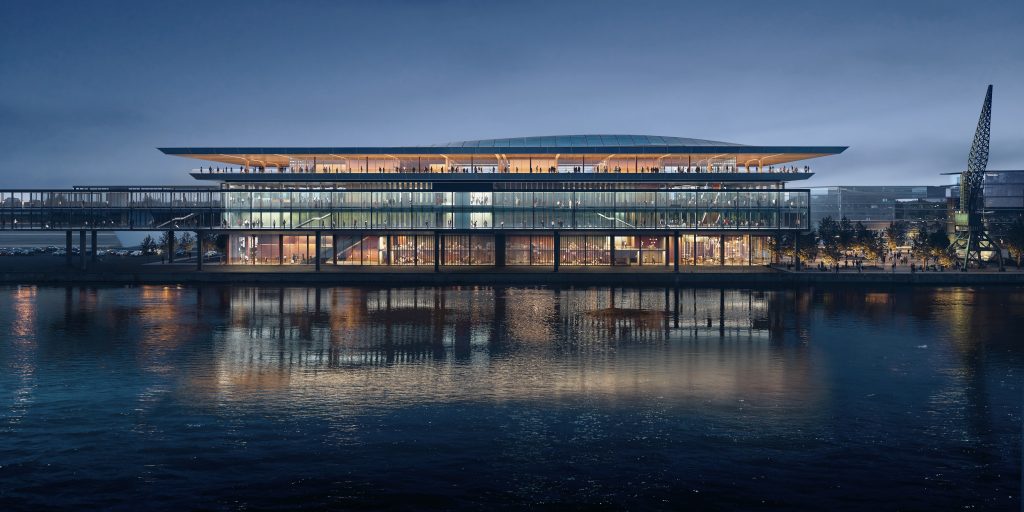
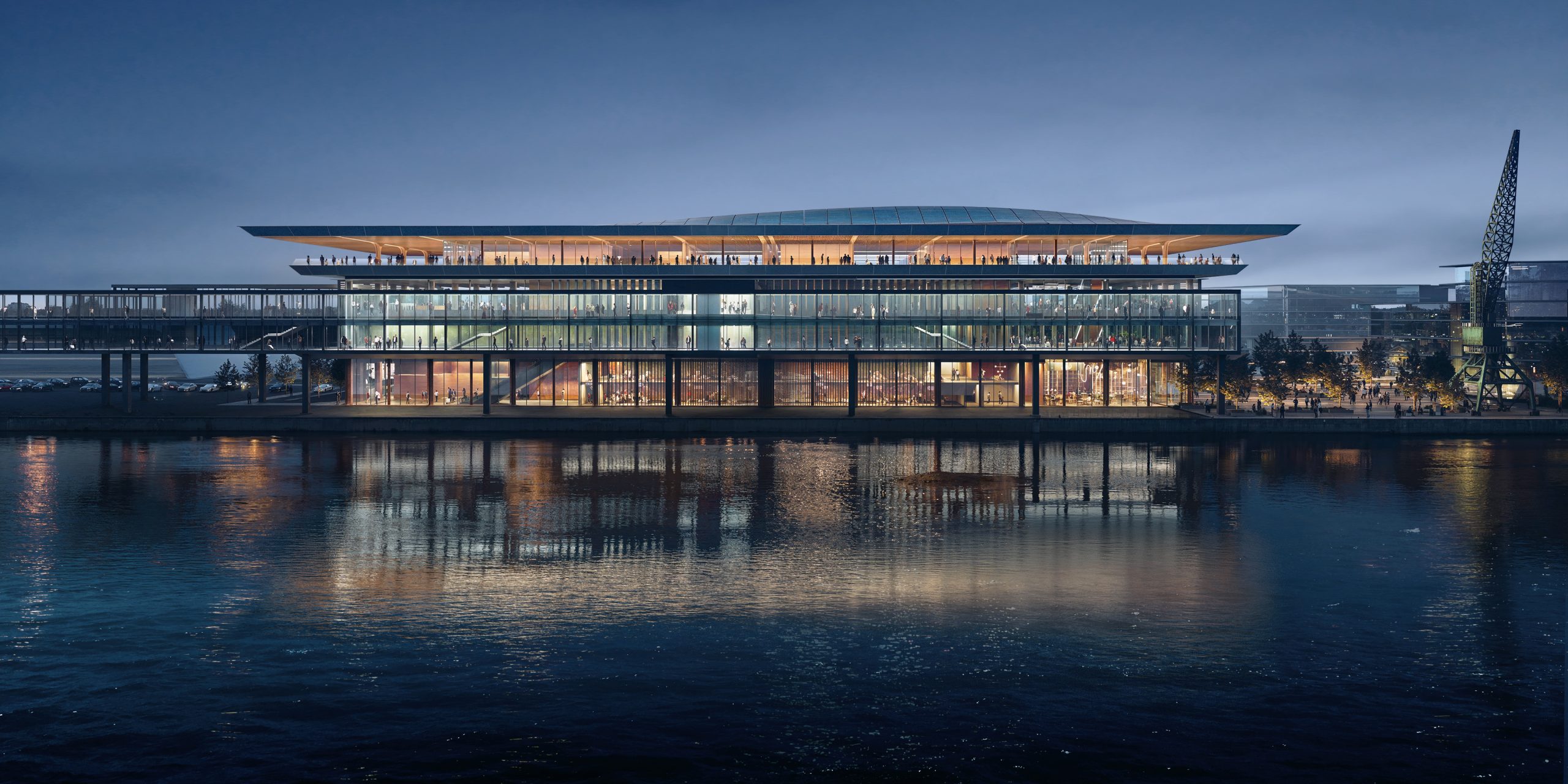
1st Place: Zaha Hadid Architects – night view from river – Render by Negativ
Arriving to board a ferry boat or cruise ship used to be a rather mundane experience. If you had luggage, you might be able to drop it off upon boarding, assuming that the boarding operation was sophisticated enough. In any case, the arrival experience was nothing to look forward to. I recall boarding the SS United States for a trip to Europe in the late 1950s. Arriving at the pier in New York, the only thought any traveler had was to board that ocean liner as soon as possible, find one’s cabin, and start exploring. If you were in New York City and arriving early, a nearby restaurant or cafe would be your best bet while passing time before boarding.
Read more…
|