If history tells us anything, the advent of a new Trump administration could have serious implications for the future of architecture in this country. Trump’s previous tenure in office saw several appointments to D.C. agencies that foretold a significant attitude change toward modern architecture. First, we might expect a repeat of
Read more…
Alster Swimming Pool after restoration (2023)
Linking Two Competitions with Three Modernist Projects
Hardly a week goes by without the news of another architectural icon being threatened with demolition. A modernist swimming pool in Hamburg, Germany belonged in this category, even though the concrete shell roof had been placed
Read more…
The Urban Confluence Silicon Valley Competition
Urban Confluence Silicon Valley winner: ©SMAR Architecture Studio
After several stops and starts over an extended period of time, the winner of the Urban Confluence Design Competition was named in early March, 2021. SMAR Architecture Studio’s The Breeze of Innovation, which prevailed over two other
Read more…
Theodore Roosevelt Presidential Library Competition
Aerial view ©Snøhetta
Until now, the establishment of presidential libraries at the conclusion of their terms has followed the founding of the Franklin Delano Roosevelt Library after World War II. The first exception to this was the Herbert Hoover Presidential Library, established in 1962.* Now a
Read more…
The Eisenhower Memorial: Sending Mixed Messages? by Stanley Collyer
Preface
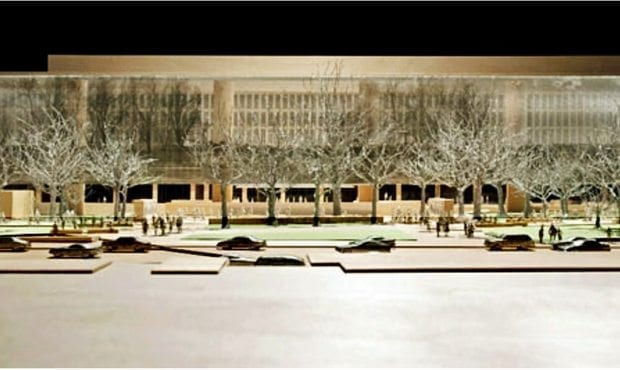
Since this article was written, several events have occurred which have changed our perception of the final design process. Frank Gehry went back to the drawing board and has modified his memorial design, eliminating some of the columns which we objected to at the edge of the site (January 2011, see above). One may only hope that the tapastry design element, which the Arts Commission still has some reservations about, can be resolved successfully.
More recently, a group called the National Civic Art Society in Washington has issued a call for another Eisenhower Memorial competition for the same site. Apparently stuck on the idea that everything in Washington near the Mall should be in the Beaux Arts traditional style, they take offense that the Gehry design does not meet their standards of what a memorial to Ike should look like. Although probably well-meaning, this group evidently would like to turn back the clock on progress in this field. They would like to erase from memory all the advancements in new materials and ideas which have surfaced and been implemented over the past century. Is it then surprising that not one architect on their board is a national name (Most of their members are laypersons). Although their competition will undoubtedly draw some entries, it should hardly be taken seriously, much less receive any attention from the press. What they are doing is adding nothing to a positive dialogue about architecture in this country—only attempting to set it back by decades. -Ed
Frank Gehry’s preferred idea for the Eisenhower Memorial was one of three proposals which the firm presented in March 2010 to the Eisenhower Memorial Commission after prevailing in the earlier selection process. Although not touted as a pure competition by the Memorial Commission, the original selection process in 2009 was typical of the General Services Administration’s Excellence in Architecture program, often used to adjudicate the design process for government projects such as federal courthouses.
Read more…
Night view of the memorial tapestry from Independence Avenue, with Gehry’s sketch of the Normandy cliffs.
Explaining the contributions of a World War II hero and later President of the United States on a very modest site on Independence Avenue just off the Washington Mall is tantamount to asking an author to describe
Read more…
View to winning entry ©KDA
Foundation non-profits are no strangers to good architecture. Ford Foundation’s forward-looking headquarters in New York City by Roche Dinkeloo was an early example of a non-profit using architecture as a vehicle for serving to brand it as a progressive institution. In 2001 the California Endowment went one
Read more…
1st Place – gmp Architekten Photo: ©Hans-Joachim Wuthenow, Berlin
As part of a policy to relocate archives of local interest outside of major Bavarian cities, a competition was staged for the design of a new archive in Kitzingen, 12 miles from the provincial capital city of Würzburg, Germany. The competition was
Read more…
Reconstituting an Abandoned Rail Line
Aerial view: courtesy WNYC
The Rails to Trails program, which gained momentum after the1984 Federal Land Banking Law—supported by the Rails-to-Trails Conservancy—has seen over 24,000 miles of trails established where rail lines once existed. Some sites were strictly urban, while others, sometimes
Read more…
Plans for the Final Expansion of Schultes’ Federal Chancellery Building
Aerial view with new addition at bottom of site (Image © Schultes Frank Architekten)
The reunification of Germany in 1989 not only had a great impact on the lives of many Germans, especially those living in the former DDR, but together with
Read more…
|
San Jose’s Urban Confluence Winner Cancelled
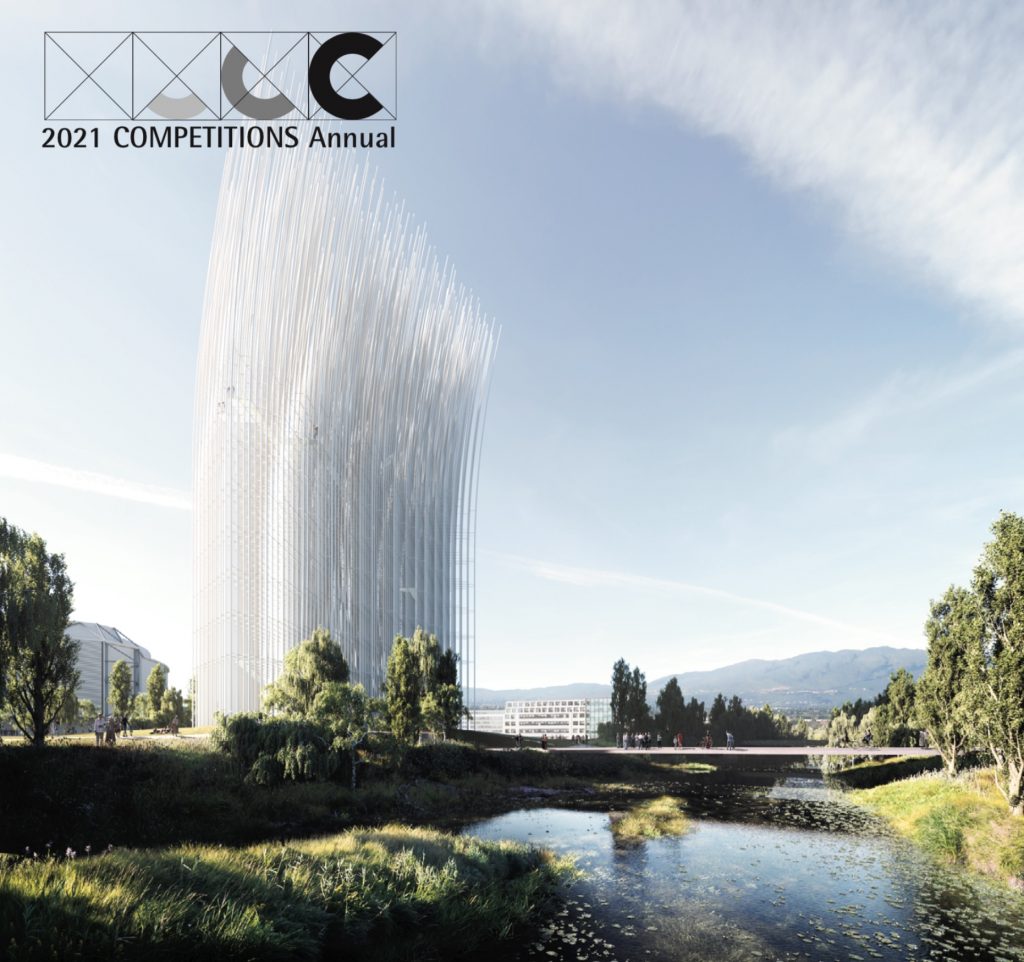
This week we received the news that the winning design for San Jose’s Urban Confluence competition by SMAR Architecture Studio has been cancelled. This comes after the original competition site was abandoned in favor of one more centrally located in downtown San Jose, Plaza de César Chávez. We can only assume that even this wasn’t enough to generate enough interest from major donors. From the very beginning of the competition, it appeared that the enthusiasm of those sponsoring the competition might be lacking links to potential donors with deep pockets—the hi-tech firms in Silicon Valley. After the competition resulted in a design that certainly entailed a major budget, the project had to be in trouble. The competition did produce a remarkable design; but this turned out to be another case where a competition, intended to generate enough public interest to fund a major project, came up short. -Ed
“A Museum for All”
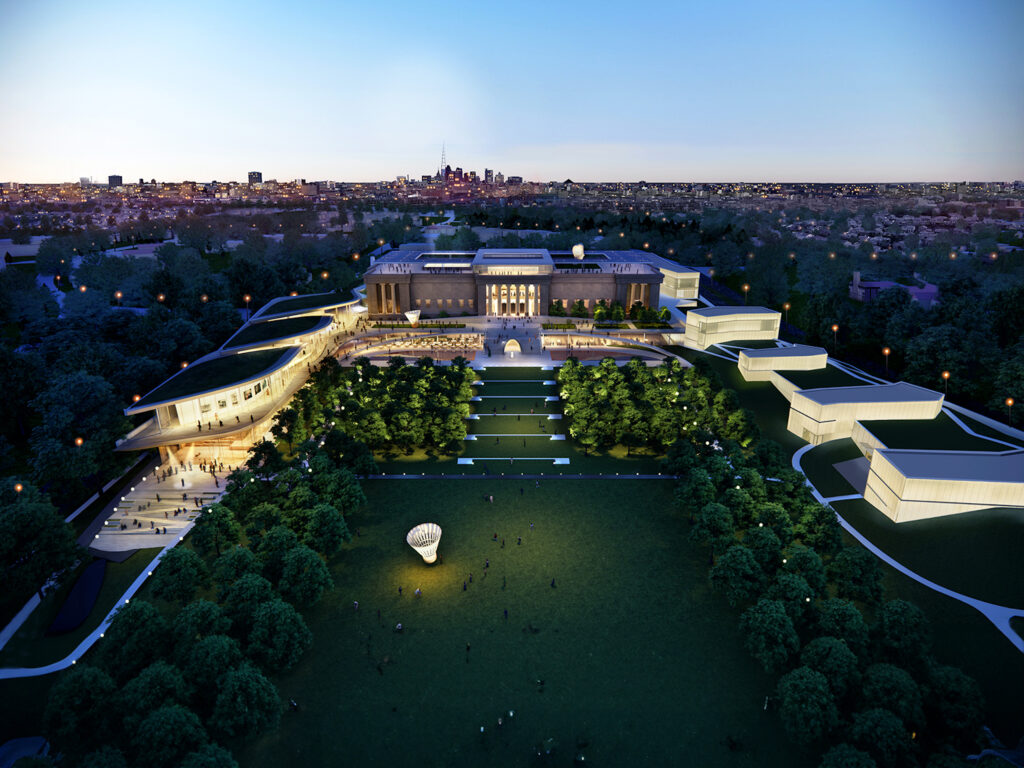
Winning entry by Weiss/Manfredi Landscape Architecture and Urbanism
Background
The Nelson-Atkins Museum of Art’s slogan “Creating a Museum for All” certainly reflects the efforts of many art museums to counter the notion that art museums exist primarily to cater to an elitist few. But one should note that this competition for an expansion of the museum’s capacity to serve a wider audience saw an initial step in this direction with the 1999 competition resulting in the Steven Holl addition, a series of pavilions stretching down one side of the large lawn area..
Read more…
Preparation and Organization of Design Competitions
[phase 1] Benjamin Hossbach / Christian Lehmhaus / Christine Eichelmann
210 × 230 mm, 192 pp.
over 600 images
softcover
ISBN 978-3-86922-316-2 (English)
ISBN 978-3-86922-240-0 (German)
Dom Publishers
€48 in EU (For price abroad, see below)
Founded in 1998 in Berlin, Phase 1 has been a principal player in the organization and facilitation of design competitions, not only in Germany, but abroad as well. The accomplishments of the firm have been well documented in three volumes—The Architecture of Competitions—beginning in 2i006. Whereas these books mainly focused on the results of the competitions they have administered, the present work, Fundamentals of Competition Management, takes one from the very beginnings of the competition process to its conclusion. The authors envisioned the publication as “three three books in one: one „blue book“ with example projects, one „yellow book“ with statements and the „white book“ with the actual guideline to competition management.”
Although there have been a number of handbooks covering the administration of designcompetitions a study covering the entire process in such detail is a welcome addition to the the literature in this field. As a contribution to this important democratic process that has yielded exceptional design for decades, this volume is not only valid for Europe, but a current overview of the process for those globally who wish to raise the level of design by virtue of a design competition. -Ed
Foreign institutions wishing to obtain a copy of the book will recieve a discount to cover the cost of foreign shipping.
To obtain a copy for that offer, go to: accounting@phase1.de
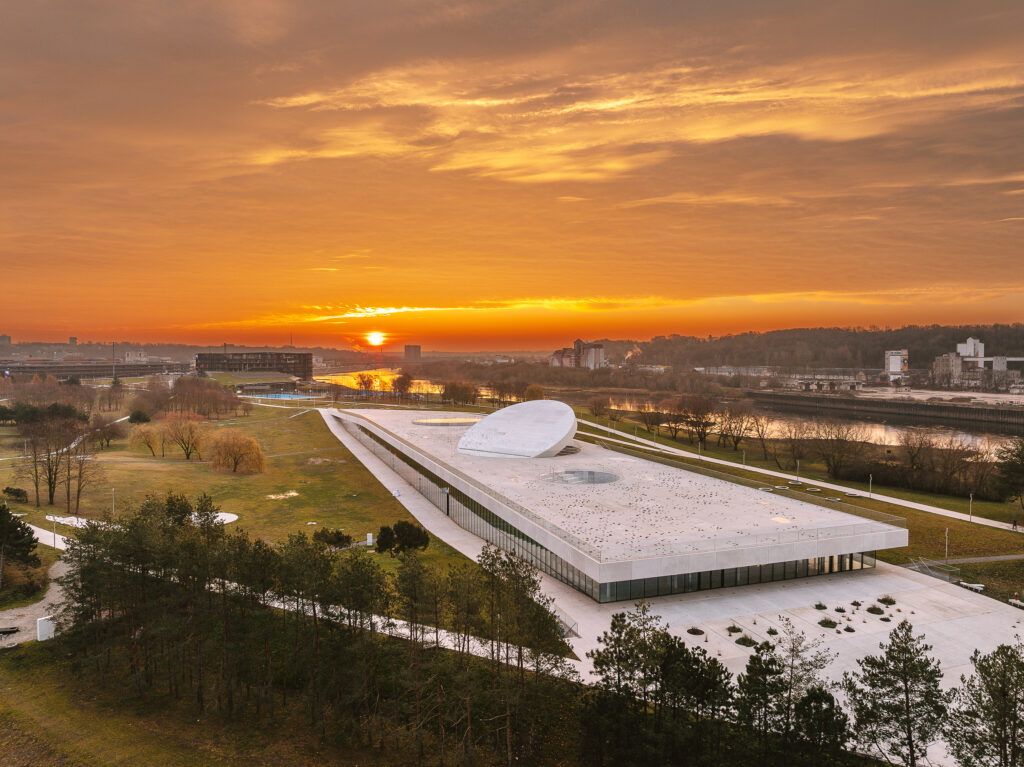
Since the recent realization of SMAR Architecture’s winning design we have now received images from a professional photo shoot. As an open competition for one of the more important projects in Europe at the time, we feel that full documentation of the process from start to finish was an important page in the history of architecture in the early 21st century. Documentation by us during the 2017 competition, with images from all finalists from the 144 entries is available at:
/competitions-static/2020/11/science-island-design-competition-finalists/
See more images…

Completed IMEX by Tuck Hinton Architects. Photo courtesy Anecdote
It is not often that we look back to a competition that occurred three decades ago that was also covered in detail by COMPETITIONS (Vol. 4, #4; pp. 14-27). What made the Chattanooga IMAX different back in 1994 was that the article covering that competition was authored by Prof. Marleen Davis, then Dean of the University of Tennessee’s School of Architecture and a member of the jury panel. This was not just a short article, covering the high points of the competition with a few talking points about the winning design. This 4,000+ word document also described in detail the jury’s observations about all the finalists, including the honorable mentions—one of the few times we have gained such a detailed glimpse in this country from the inside of the competition process.
Read more…
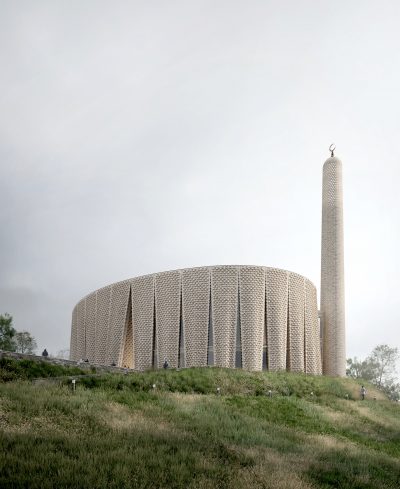
Winning entry by Luca Poian Forms Image ©Filippo Bolognese images
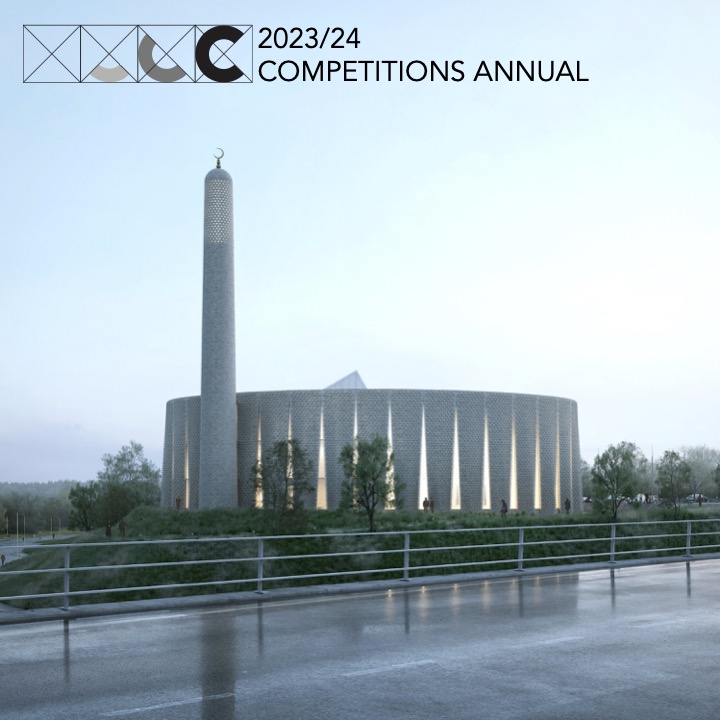
Good design seldom happens in a vacuum. And so it was with an international competition for a new mosque in Preston, U.K. A mid-sized city of 95,000, and located in Lancashire near the west coast and almost equally distant from London and Glasgow, Preston has a storied past, going all the way back to the Romans and the late Middle Ages, where it was the site of significant battles. During the Industrial Revolution, the city prospered, and it was not until after World War II that Preston experienced the British version of the U.S. Rust Belt. In the meantime, the city has experienced an upswing in economic activity, with an unemployment rate of only 3%. Aside from the appearance of new industries, the city has benefitted from the establishment of Central Lancashire University (CLU), which employs over 3,000 faculty and staff, and, as such, is one of the regions major employers. Any new university requires new facilities, and one of the most outstanding examples of this at CLU was the new Student Centre and Plaza, a result of a 2016 RIBA-sponsored competition won by Hawkins/Brown
Read More
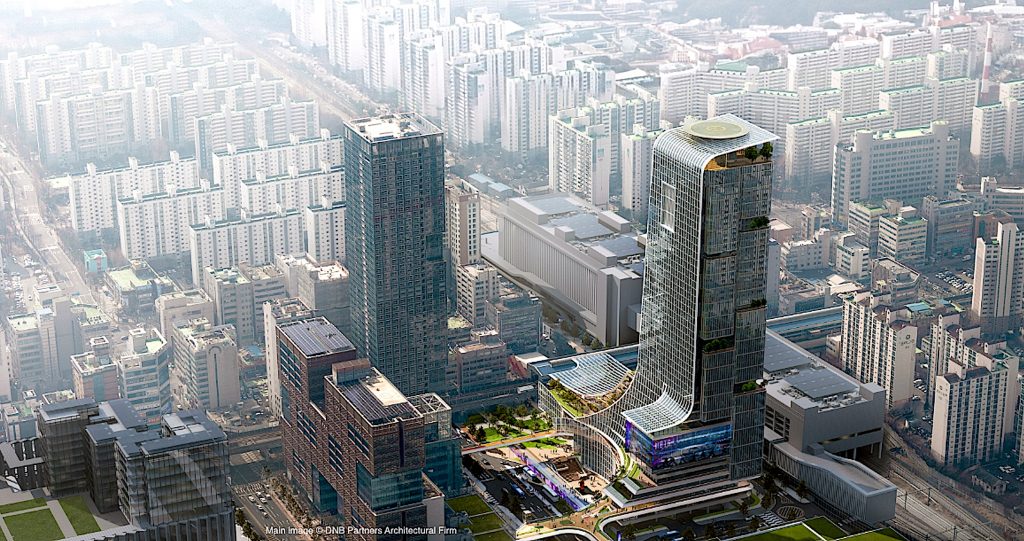
Changdong Station winner – image ©D & B Partners Architects
Whereas international competitions for real projects have become a rarity lately, Korea is a welcome exception. Among the plethora of competition announcements we receive almost weekly, several have ended with foreign firms as winners. But the history of welcoming international participants does go back several years. One notable early example was the Incheon Airport competition, won by Fentress Bradburn Architects (1962-70).
Among the more recent successes of foreign firms was the Busan Opera House competition, won by Snøhetta (2013-) and the Sejong Museum Gardens competition, won by Office OU, Toronto (2016-2023).
Read more…
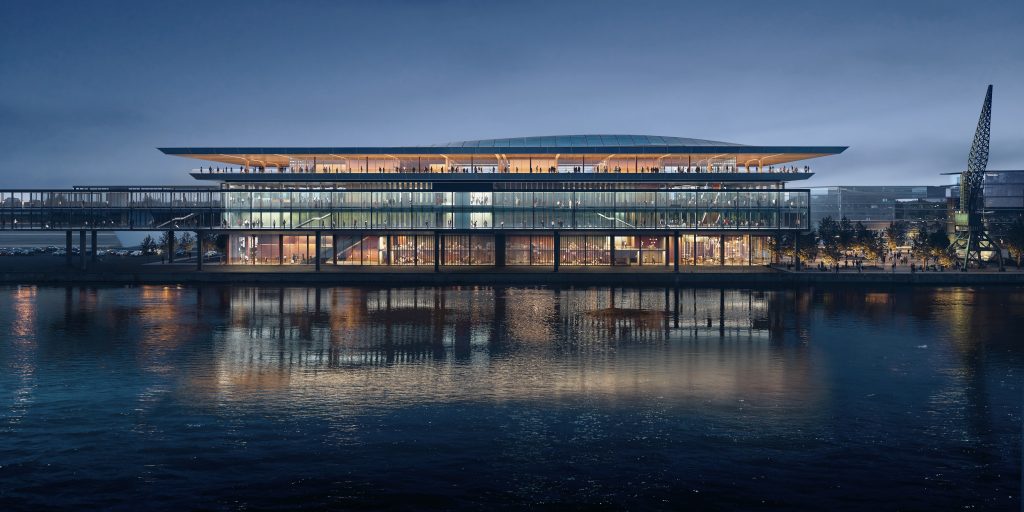
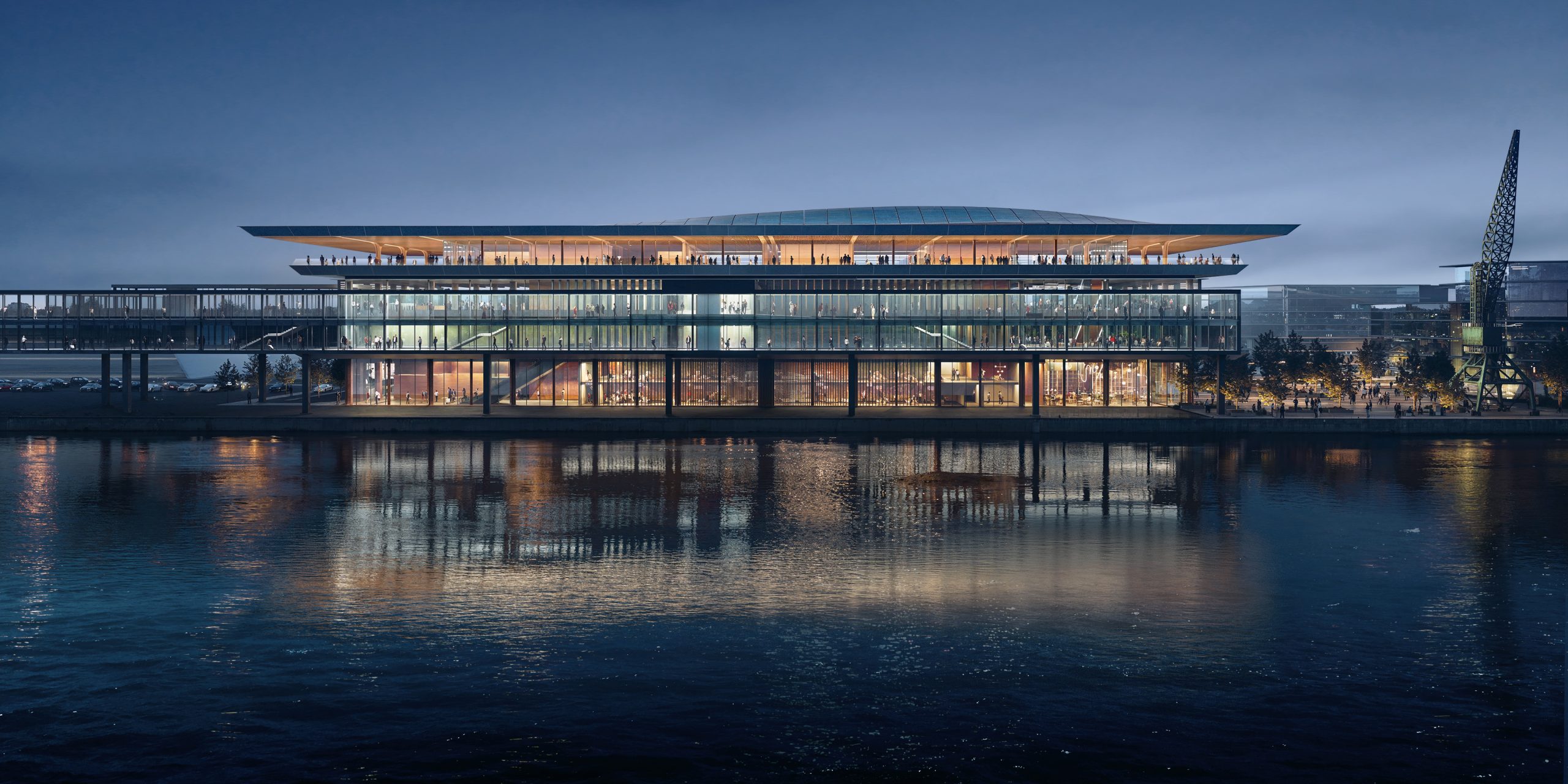
1st Place: Zaha Hadid Architects – night view from river – Render by Negativ
Arriving to board a ferry boat or cruise ship used to be a rather mundane experience. If you had luggage, you might be able to drop it off upon boarding, assuming that the boarding operation was sophisticated enough. In any case, the arrival experience was nothing to look forward to. I recall boarding the SS United States for a trip to Europe in the late 1950s. Arriving at the pier in New York, the only thought any traveler had was to board that ocean liner as soon as possible, find one’s cabin, and start exploring. If you were in New York City and arriving early, a nearby restaurant or cafe would be your best bet while passing time before boarding.
Read more…
|