The O’Hare International Airport Competition
Winning entry – Studio-ORD
The updating and modernization of Chicago’s O’Hare Airport has been well overdue. Aside from occasional problems caused by Chicago’s winter storms, congestion at the airport has led air travelers to avoid the airport when catching a connecting flight is on the agenda.
Read more…
Reconstituting an Abandoned Rail Line
Aerial view: courtesy WNYC
The Rails to Trails program, which gained momentum after the1984 Federal Land Banking Law—supported by the Rails-to-Trails Conservancy—has seen over 24,000 miles of trails established where rail lines once existed. Some sites were strictly urban, while others, sometimes
Read more…
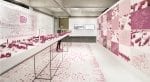
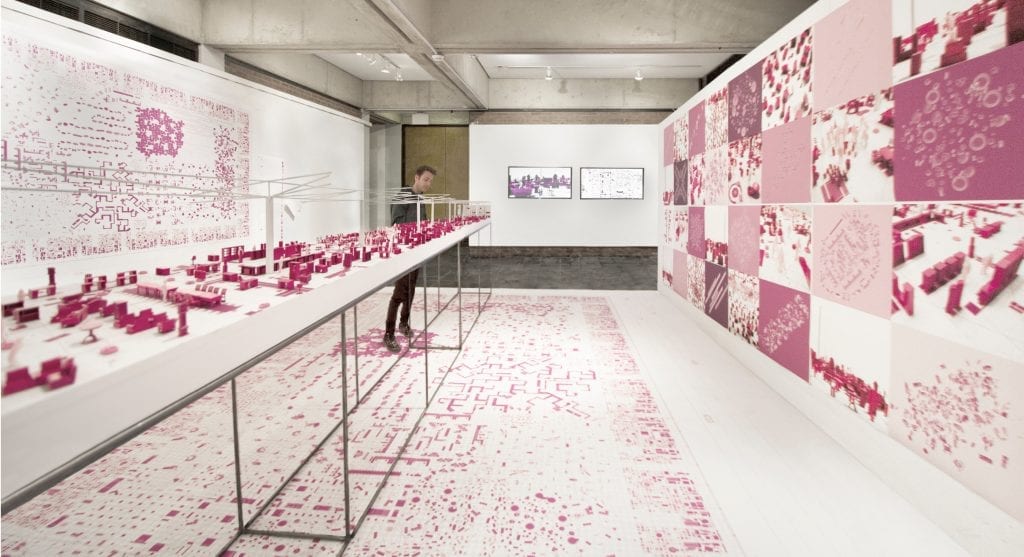
Winner: “Collective Clutter,” installation view, Princeton University. (Photo: Courtesy of Lily Zhang)
When one thinks of infrastructure, it’s usually about roads, rails, bridges, airports, canals, pipelines, and any- and everything about getting from one place to another. But leave it to the Steedman competition to stimulate designers to view things from a different point of view.
In the 2016/17 Steedman competition, won by Pedro Pitarch of Spain, the winner explored the theme, “Adaptation,” and convinced the jury with his proposal, Disguised Metropolitanisms: Unveiling the Masquerade of Urban Domesticity. Pitarch’s point of departure? “There has been a migration from the right of property to the right of access and use,” argued Pedro Pitarch. “Spaces are no longer used according to their architectural program, but according to their protocols, their accessibility, and their possibilities of empowerment.”
Read more…
Winning design © Gottlieb Paludan Architects with Strasky, Husty and Partners
The U.K. is no stranger to pedestrian bridge competitions. Both the Salford Pedestrian Bridge competition (2013) and Tintagel Castle Pedestrian Bridge (2014) were commissioned by virtue of a request for qualifications and the shortlisting process. Both were administered by the
Read more…
An “eco-district” Master Plan
Winning plan by Knight Frank (all images courtesy centeragency.org)
Moscow has been short on housing for decades. Now the need for housing in the far-flung reaches of the Russian Federation is taking shape. Kazan, a city east of Moscow on the upper reaches of the Volga River
Read more…

Winning entry by Morphosis (image ©Morphosis)
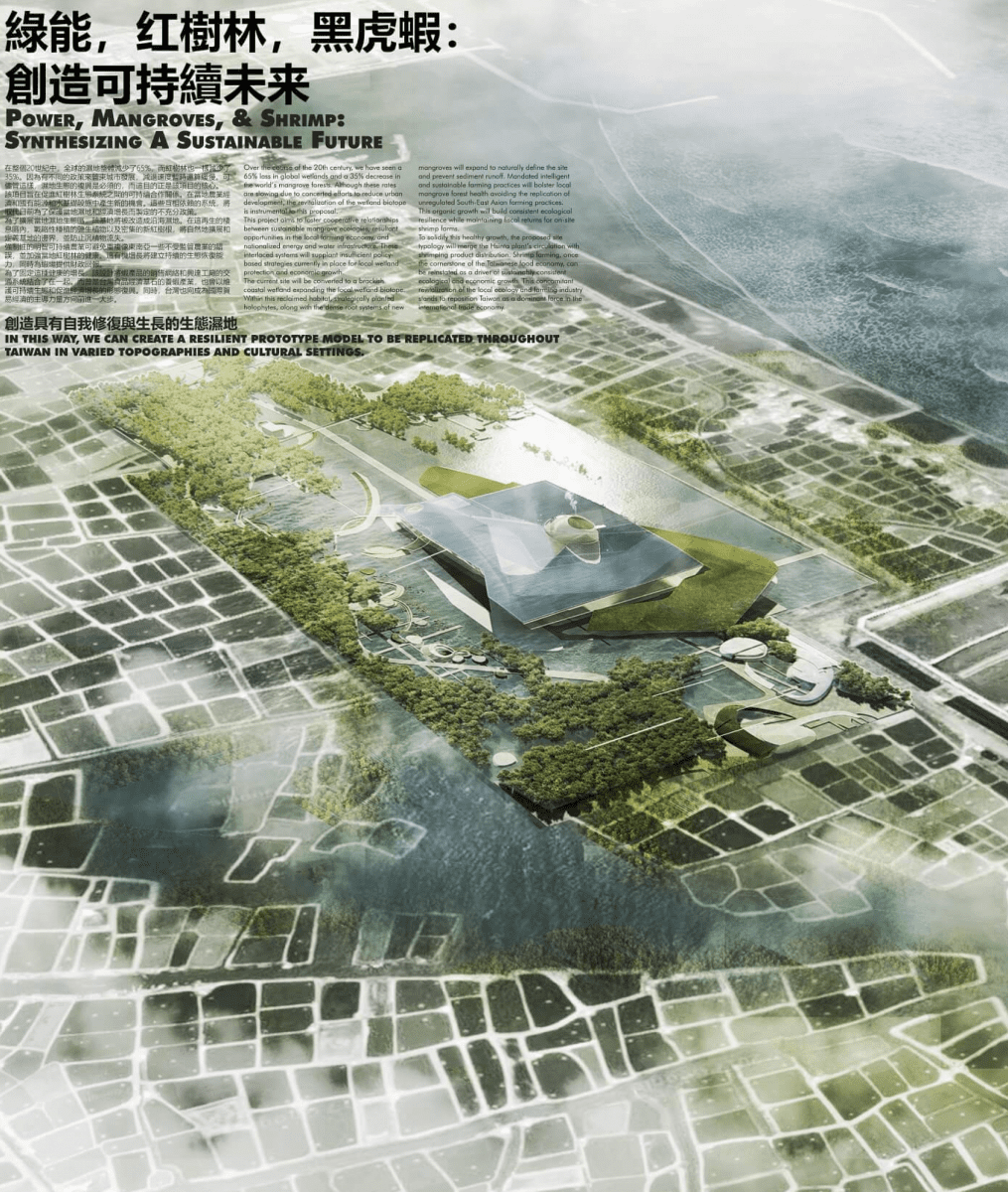
Whether it was the establishment of a shrimp industry, general water and flood abatement, or a site for bird migration, the Hsinta Ecological Power Plant competition produced a plethora of interesting approaches to mitigate the negative effects normally associated with the introduction of a power plant. With one possible exception, each of the five finalists in this international, two-stage competition showed an extensive amount of research to support their design strategies and the underlying sustainability features.
Read more…
Finetuning a Sydney Suburb’s Future
Winning Entry: ©James Mather Delaney (JMD Design}
Competitions in Australia have become more commonplace than could have become anticipated two decades ago. It was in the early 1990s that Sydney’s mayor, Frank Sartore, decided that competitions could improve on the rather mediocre architecture so prevalent
Read more…

View of site from south Rendering ©SO-IL
In Paris, it’s no longer just about Grands Projets. Lately, the French have become more focused on areas bordering the Seine River, and how to turn them into more attractive destinations for locals and visitors alike. The most recent projet, and the subject of a competition, was Place Mazas, located on the Right Bank of the Seine in the 12th District. Partially because of the bordering highway’s proximity to the river, the site is underused and hardly regarded as a high profile destination.
Now that may all change. The competition, won by the New York-based firm, SO-IL, has conceived a plan, which will create a series of park areas and structures relating to the current needs of the community. Sustainability is almost always on the front burner in these competitions, and this was no exception. SO-IL’s plan for the site’s only major building is a seven-story structure made primarily of wood. Although situated all by itself at the end of a street—bordering on the Seine—its shape and size serve to address the composition of the streetscape in a very logical, spatial manner. According to the intent of the winner, “This volume includes a housing program in co-living typology, with several interior and exterior shared spaces for the residents as well as a public restaurant on the ground floor.”

Arsenal Basin Rendering ©SO-IL
The rest of the site is devoted to “public activities,” opening up views to the Seine River and includes a repurposed 1905 lockhouse and a “temporary pavilion” hosting facilities like public co-working spaces, a fabricaion lab, an event room and a terrace offering views on the Arsenal Basin, the river, and the surrounding city, “as well as a facility for homeless care already established on site.” Labeling the pavilion as a “temporary” structure is based on the assumption that neighborhoods are always evolving, and that future changes could be in store.
Read more…

Winning entry courtesy: KPMB Architects + West 8 + Greenberg Consultants
Access from downtown Toronto to its waterfront has been an ongoing issue for the city fathers for the past decades. One of the major visual barriers to Lake Ontario is the Gardiner Expressway, just a few blocks from the waterfront and the subject of a 2010 competition. It was abandoned with no premiated designs and no indication of future solution. Participants in that competition were familiar faces: KPMB + Bjarke Ingels Group, Rem Koolhaas/OMA, James Corner Field Operations, Diller Scofidio + Renfro/ Architects Alliance, West 8 DTAH/Cecil Balmond AGU, and Adrian Smith + Gordon Gill Architecture (See: http://gardinereast.ca/design-ideas). Part of the problem with either burying the Gardiner or eliminating it altogether within the central core did not have so much to do with political will, but the lack of funding at the municipal level.
One piece of the puzzle has now been addressed—the ferry terminal on the waterfront and its environs. Although the site is confined to a relatively small area, the vision for rethinking the possibilities of making it more pedestrian and user-friendly have been the subject of a recent competition, with five invited firms vying for the opportunity to realize their proposals.
What made this competition so interesting were not only the challenges of packing a number of required elements into a relatively small site—without giving the impression of crowd congestion—but also the organized flow of several thousand departing (and arriving) passengers headed for offshore islands and other destinations on Lake Ontario. Combined with all that were the aesthetics—the visual impressions of arrival, departure and a park-like setting, as well as the location of the necessary terminal structure(s).
The competition itself was launched as an RfQ, with five shortlisted firms invited to present schemes in a single-stage competition. They were:
• Stoss Landscape Urbanism (Boston) + nARCHITECTS (New York City) + ZAS
Architects (Toronto)
• Clement Blanchet Architecture (Paris) + Batlle i Roig (Barcelona) + RVTR (Toronto and Ann Arbor) + Scott Torrance Landscape Architect Inc. (Toronto)
• Diller Scofidio+Renfro (New York City) + architectsAlliance (Toronto) + Hood Design (Emeryville, CA)
• KPMB Architects (Toronto), West 8 (Rotterdam), Greenberg Consultants (Toronto)
• Quadrangle Architects (Toronto), aLLDesign (London), Janet Rosenberg & Studio (Toronto)
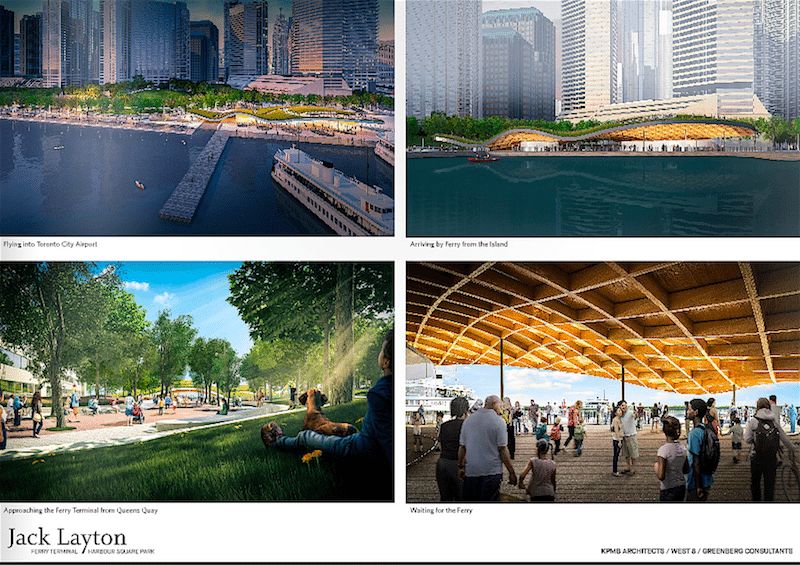
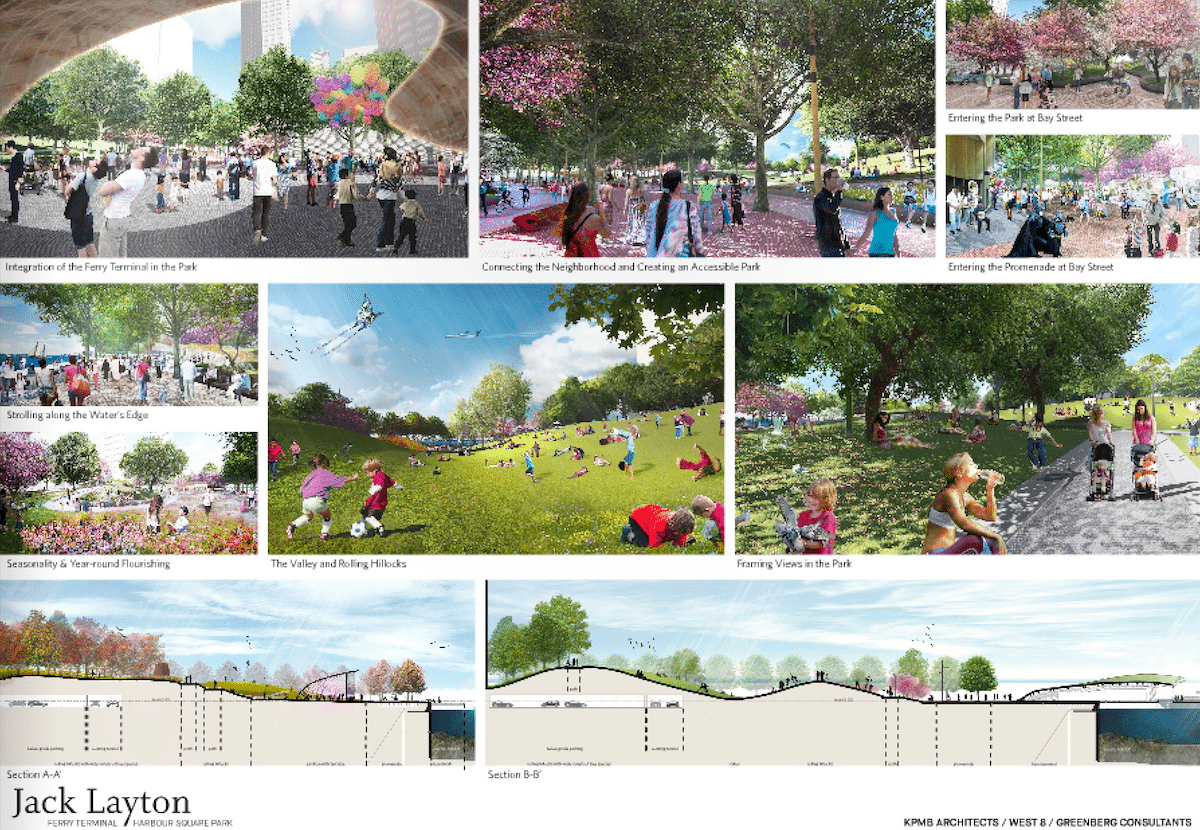
The major departure features of all but one of the entries were the location of two-tier structures directly across from the ferry docks, with two having large canopies as shelter, and two providing rooftop parks with outlooks to the Lake. One of the latter was the winner of the competition, KPMB of Toronto with landscape architecture firm West 8 of Rotterdam and Greenberg Consultants (planning) of Toronto.
KPMB’s main entrance to the Ferry Terminal from Bay Street is a parklike entrance, creating a promenade eventually leading to an entrance to the processing area for passengers, with the option to climb up an elevated rooftop extension of the park where one finds a meandering pathway leading to a lookout area. From the eastern side, the path is also accessible from Yonge Street, also leading into the park. Parking is located under a hill in the park, with ticket processing and waiting areas for the boats located under the park extension canopy. The area to the west of the Terminal is a generous park area, which includes a slip for recreational craft.
KPMB’s meeting with planning and port authorities after winning the competition was instructional for the subject matter discussed: most of the emphasis concerned the ability of the facility to accommodate increasing numbers of visitors in the future. Aesthetics were a low priority in the discussion, an indication that financial issues were not a serious problem at this development stage of the process.
    
Winning entry courtesy: KPMB Architects + West 8 + Greenberg Consultants
Read more…
COMPETITIONS: I am presently here in London to talk to my editor about a ‘how to’ book we are doing on competitions.
JOHN MCASLAN: And how not to do them, I hope.
COMPETITIONS: You’re familiar with one of those?
JM: We recently did one—Middlesborough Town Hall. It caused a real furor here.
COMPETITIONS: Usually the RIBA competitions are well organized.
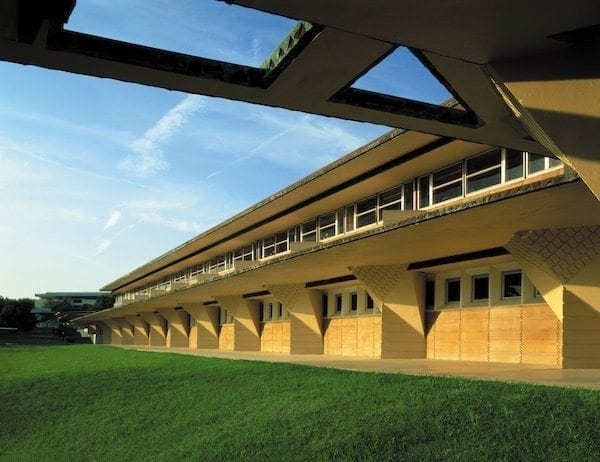
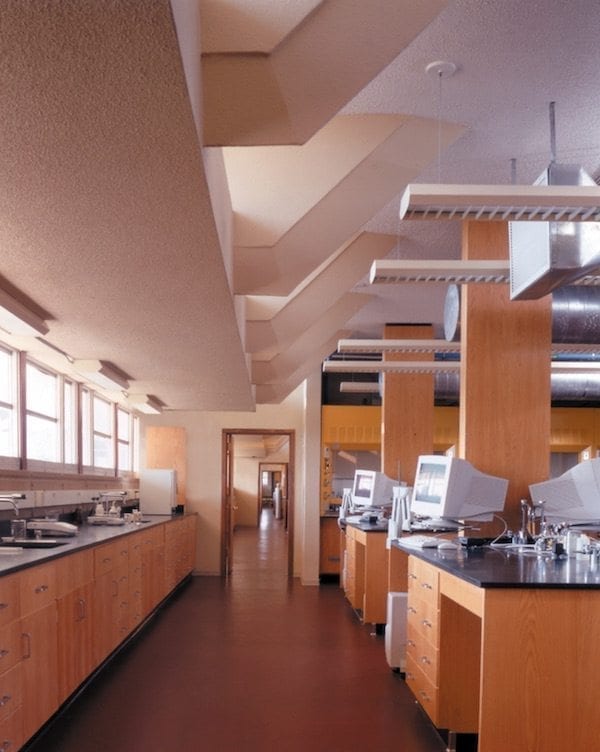
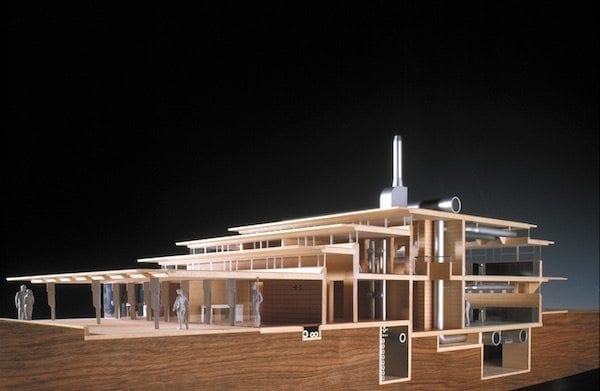
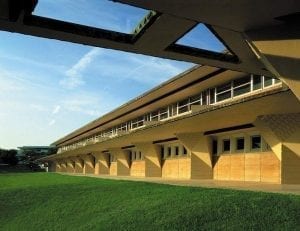
Science Center, Florida Southern College (1996-2001)
JM: This was an open, non-RIBA competition to re-market (rebuild) the Town Hall in Middlesborough, a town which had quite a good artistic tradition. About ten years ago they commissioned Claes Oldenburg to design a sculpture. There was also a competition for a museum there—which we didn’t get. And then there was the competition for the Town Hall, where we got to the last six. It was chaotic, as to what was to be submitted. There was a lot of to-ing and fro-ing, because the terms of reference weren’t clear. And then there were long delays before the interviews. Finally we were asked to submit a tender(fee bid). But of the six tenders, only four arrived on time. Because of that, the two late tenderers were eliminated. I thought, ‘well, you know you have to get them in on time.’ But then one of the jurors walked out, because she thought it unfair that these two had been eliminated. Then it came out that they had opened the bids before the interviews took place.
We were only runners-up; but the whole thing has caused chaos because of the sloppiness with which the whole thing was organized. They should have selected the preferred team , then opened the bids.
You asked about the RIBA competitions. We have won some and lost a some. But you can say that they are always immaculately organized—very transparent, no confusion over what is required when. If a competition is badly administered with lots of criticism, it doesn’t help at all, especially with funding.
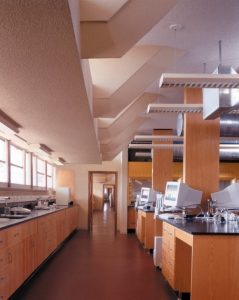 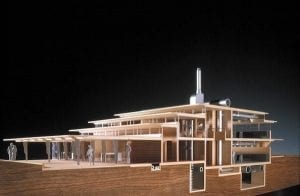
Science Center, Florida Southern College (1996-2001) Lab interior (left) and model (right)
COMPETITIONS: You were recently in the Fresh Kills competition in the U.S.
Read more…
|
San Jose’s Urban Confluence Winner Cancelled
This week we received the news that the winning design for San Jose’s Urban Confluence competition by SMAR Architecture Studio has been cancelled. This comes after the original competition site was abandoned in favor of one more centrally located in downtown San Jose, Plaza de César Chávez. We can only assume that even this wasn’t enough to generate enough interest from major donors. From the very beginning of the competition, it appeared that the enthusiasm of those sponsoring the competition might be lacking links to potential donors with deep pockets—the hi-tech firms in Silicon Valley. After the competition resulted in a design that certainly entailed a major budget, the project had to be in trouble. The competition did produce a remarkable design; but this turned out to be another case where a competition, intended to generate enough public interest to fund a major project, came up short. -Ed
“A Museum for All”
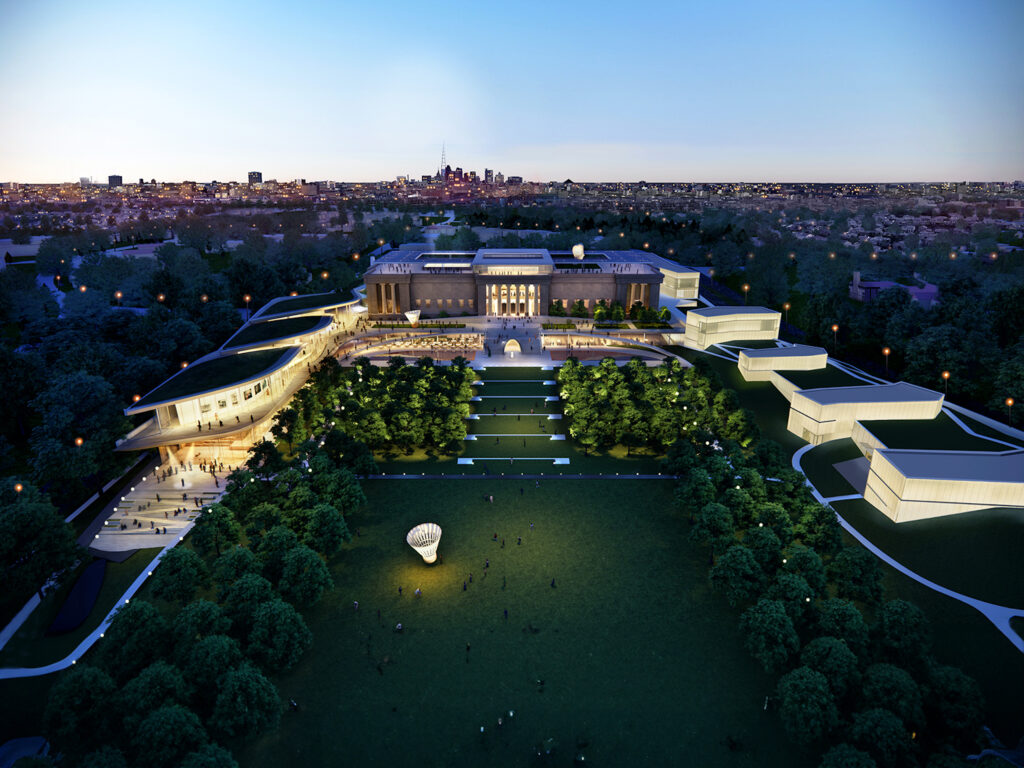
Winning entry by Weiss/Manfredi Landscape Architecture and Urbanism
Background
The Nelson-Atkins Museum of Art’s slogan “Creating a Museum for All” certainly reflects the efforts of many art museums to counter the notion that art museums exist primarily to cater to an elitist few. But one should note that this competition for an expansion of the museum’s capacity to serve a wider audience saw an initial step in this direction with the 1999 competition resulting in the Steven Holl addition, a series of pavilions stretching down one side of the large lawn area..
Read more…
Preparation and Organization of Design Competitions
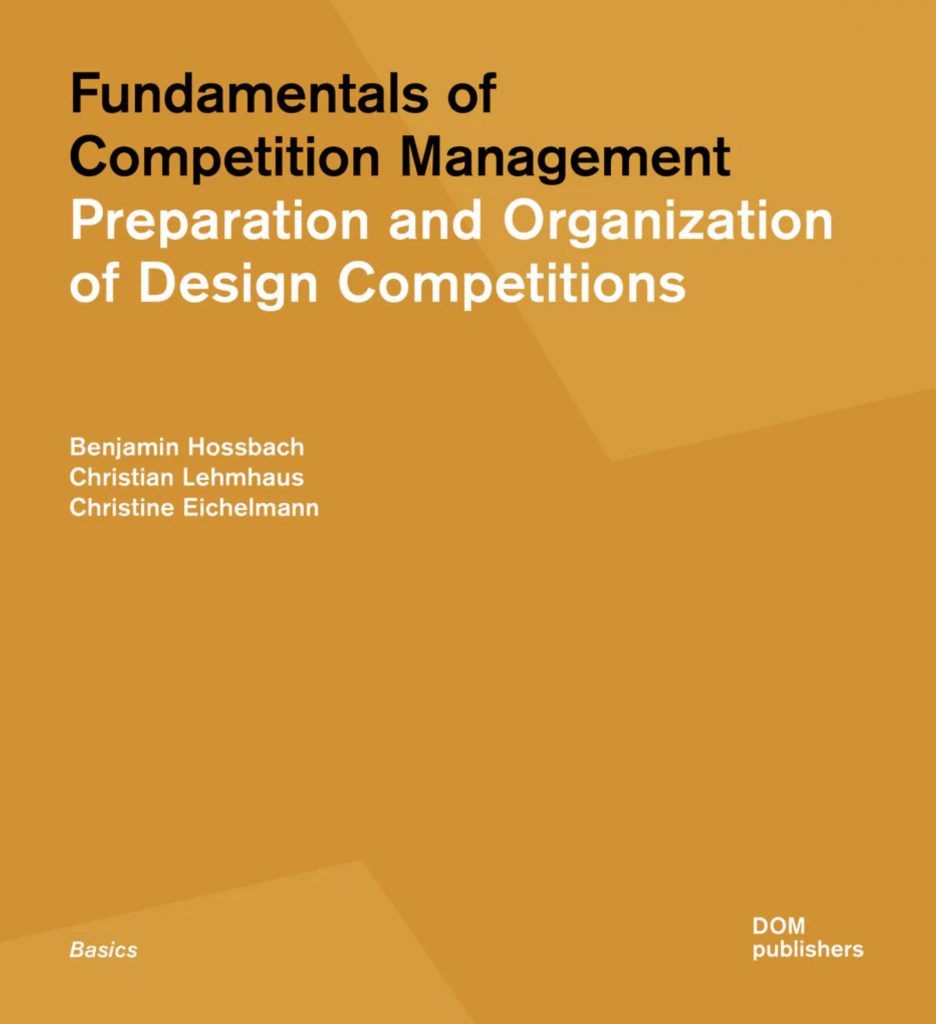
[phase 1] Benjamin Hossbach / Christian Lehmhaus / Christine Eichelmann
210 × 230 mm, 192 pp.
over 600 images
softcover
ISBN 978-3-86922-316-2 (English)
ISBN 978-3-86922-240-0 (German)
Dom Publishers
€48 in EU (For price abroad, see below)
Founded in 1998 in Berlin, Phase 1 has been a principal player in the organization and facilitation of design competitions, not only in Germany, but abroad as well. The accomplishments of the firm have been well documented in three volumes—The Architecture of Competitions—beginning in 2i006. Whereas these books mainly focused on the results of the competitions they have administered, the present work, Fundamentals of Competition Management, takes one from the very beginnings of the competition process to its conclusion. The authors envisioned the publication as “three three books in one: one „blue book“ with example projects, one „yellow book“ with statements and the „white book“ with the actual guideline to competition management.”
Although there have been a number of handbooks covering the administration of designcompetitions a study covering the entire process in such detail is a welcome addition to the the literature in this field. As a contribution to this important democratic process that has yielded exceptional design for decades, this volume is not only valid for Europe, but a current overview of the process for those globally who wish to raise the level of design by virtue of a design competition. -Ed
Foreign institutions wishing to obtain a copy of the book will recieve a discount to cover the cost of foreign shipping.
To obtain a copy for that offer, go to: accounting@phase1.de
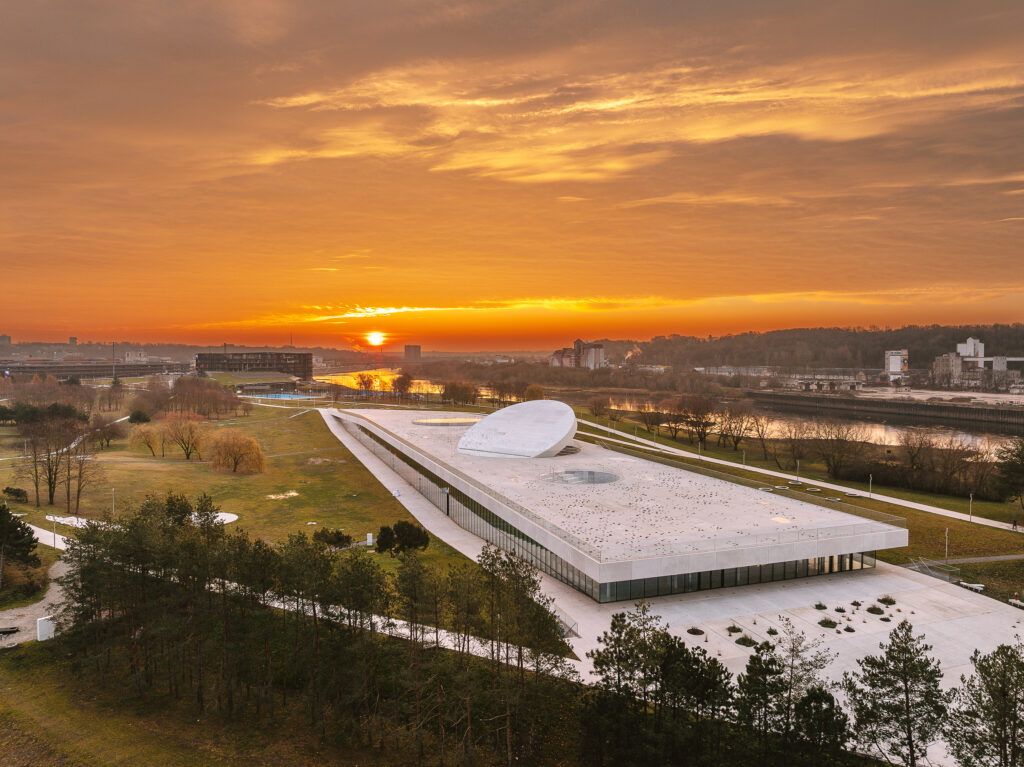
Since the recent realization of SMAR Architecture’s winning design we have now received images from a professional photo shoot. As an open competition for one of the more important projects in Europe at the time, we feel that full documentation of the process from start to finish was an important page in the history of architecture in the early 21st century. Documentation by us during the 2017 competition, with images from all finalists from the 144 entries is available at:
/competitions-static/2020/11/science-island-design-competition-finalists/
See more images…

Completed IMEX by Tuck Hinton Architects. Photo courtesy Anecdote
It is not often that we look back to a competition that occurred three decades ago that was also covered in detail by COMPETITIONS (Vol. 4, #4; pp. 14-27). What made the Chattanooga IMAX different back in 1994 was that the article covering that competition was authored by Prof. Marleen Davis, then Dean of the University of Tennessee’s School of Architecture and a member of the jury panel. This was not just a short article, covering the high points of the competition with a few talking points about the winning design. This 4,000+ word document also described in detail the jury’s observations about all the finalists, including the honorable mentions—one of the few times we have gained such a detailed glimpse in this country from the inside of the competition process.
Read more…
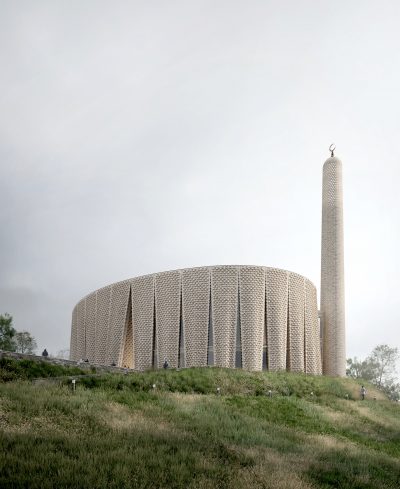
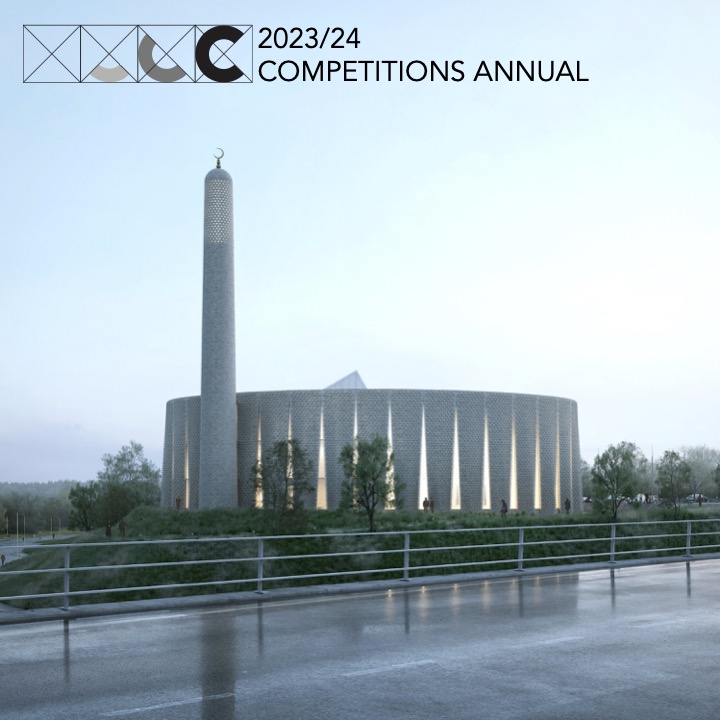
Winning entry by Luca Poian Forms Image ©Filippo Bolognese images
Good design seldom happens in a vacuum. And so it was with an international competition for a new mosque in Preston, U.K. A mid-sized city of 95,000, and located in Lancashire near the west coast and almost equally distant from London and Glasgow, Preston has a storied past, going all the way back to the Romans and the late Middle Ages, where it was the site of significant battles. During the Industrial Revolution, the city prospered, and it was not until after World War II that Preston experienced the British version of the U.S. Rust Belt. In the meantime, the city has experienced an upswing in economic activity, with an unemployment rate of only 3%. Aside from the appearance of new industries, the city has benefitted from the establishment of Central Lancashire University (CLU), which employs over 3,000 faculty and staff, and, as such, is one of the regions major employers. Any new university requires new facilities, and one of the most outstanding examples of this at CLU was the new Student Centre and Plaza, a result of a 2016 RIBA-sponsored competition won by Hawkins/Brown
Read More
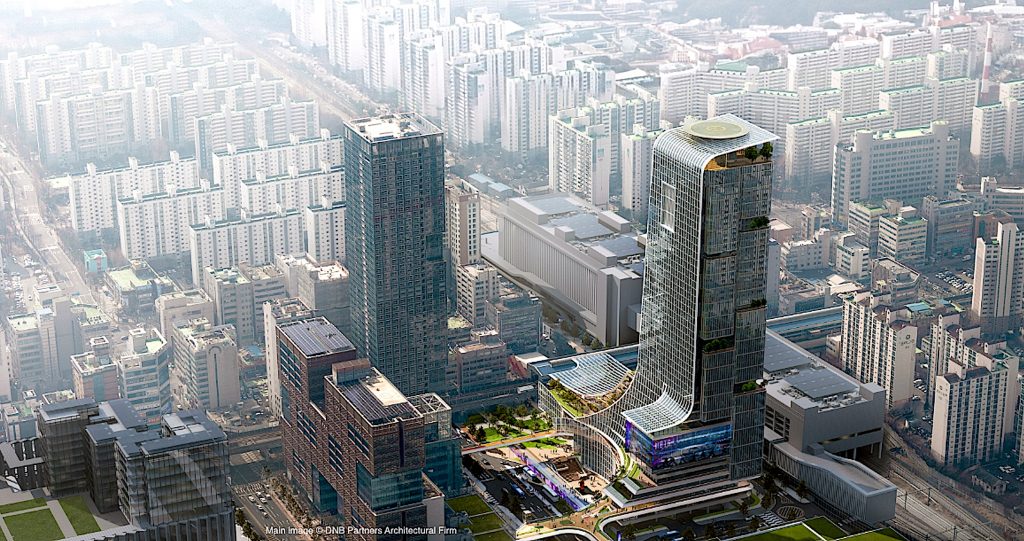
Changdong Station winner – image ©D & B Partners Architects
Whereas international competitions for real projects have become a rarity lately, Korea is a welcome exception. Among the plethora of competition announcements we receive almost weekly, several have ended with foreign firms as winners. But the history of welcoming international participants does go back several years. One notable early example was the Incheon Airport competition, won by Fentress Bradburn Architects (1962-70).
Among the more recent successes of foreign firms was the Busan Opera House competition, won by Snøhetta (2013-) and the Sejong Museum Gardens competition, won by Office OU, Toronto (2016-2023).
Read more…
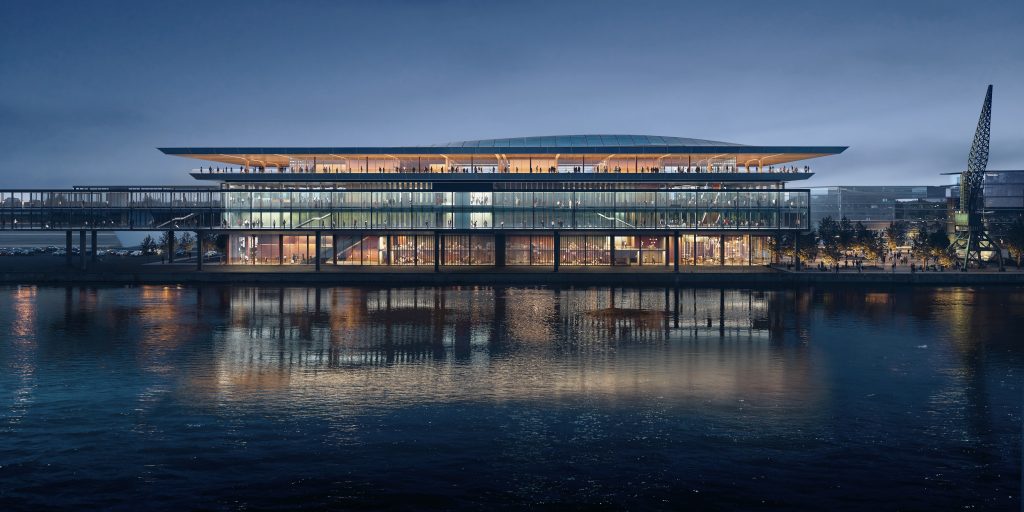
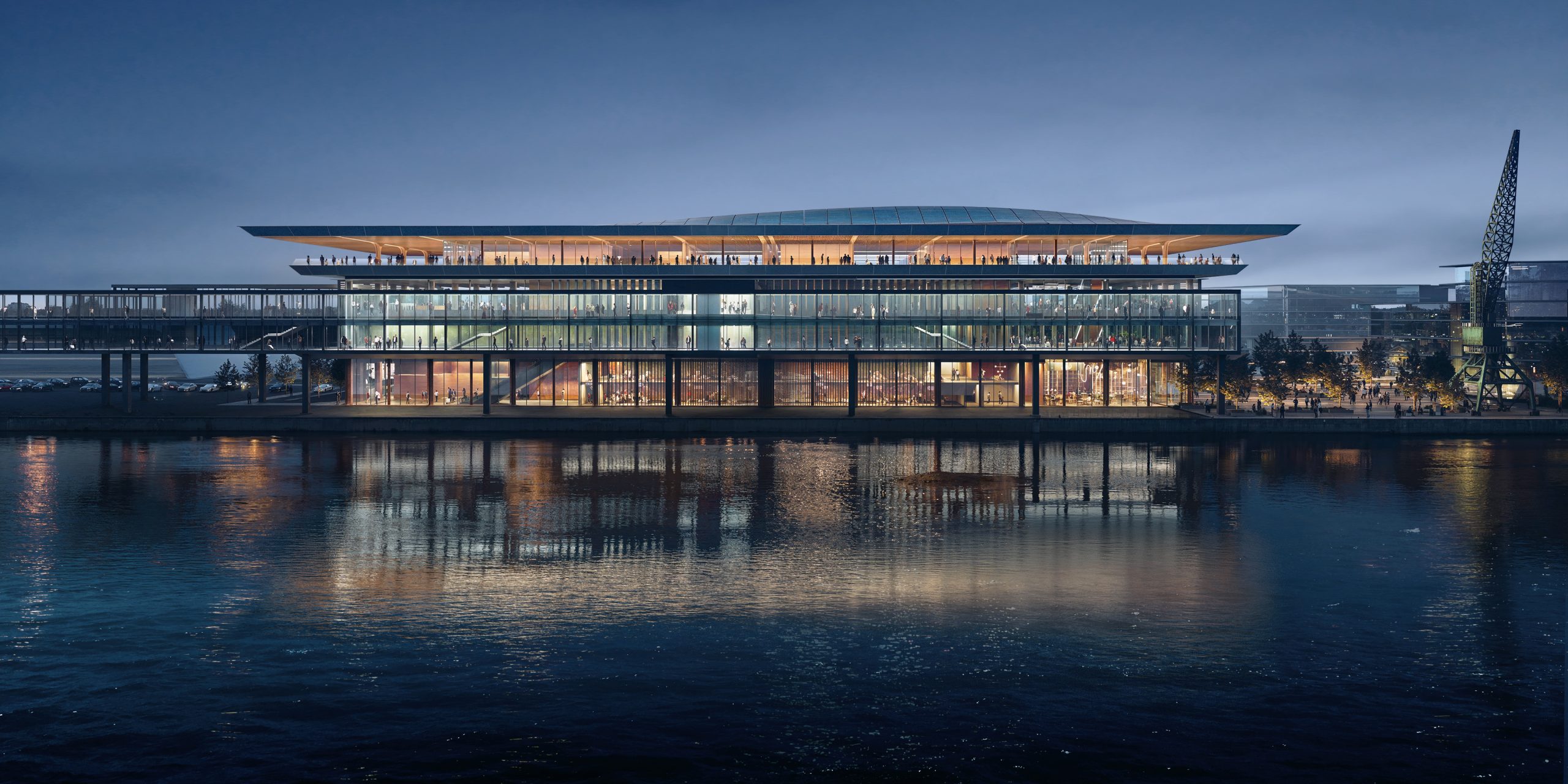
1st Place: Zaha Hadid Architects – night view from river – Render by Negativ
Arriving to board a ferry boat or cruise ship used to be a rather mundane experience. If you had luggage, you might be able to drop it off upon boarding, assuming that the boarding operation was sophisticated enough. In any case, the arrival experience was nothing to look forward to. I recall boarding the SS United States for a trip to Europe in the late 1950s. Arriving at the pier in New York, the only thought any traveler had was to board that ocean liner as soon as possible, find one’s cabin, and start exploring. If you were in New York City and arriving early, a nearby restaurant or cafe would be your best bet while passing time before boarding.
Read more…
|